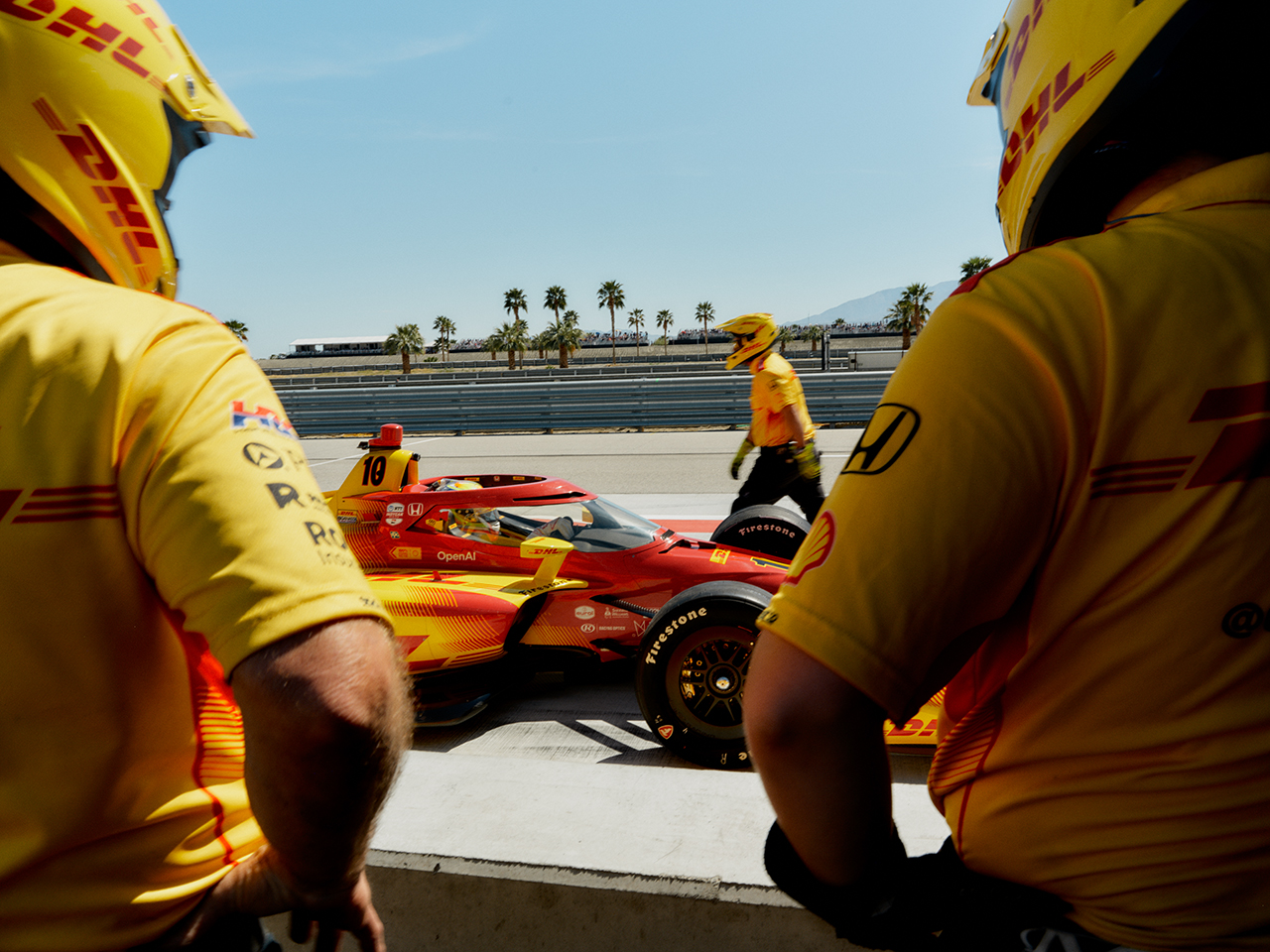
In March 2024, Álex Palou won the $1 Million Challenge, a 20-lap, made-for-TV race at The Thermal Club. The winner was not exactly a surprise, but his postrace comments were. He dedicated the jackpot to buying diapers for his baby, Lucia. Palou then blasted through the season and won the NTT IndyCar Series for the third time in four years.
A year later, IndyCar’s inaugural Thermal Grand Prix drew 11 teams and 27 cars on the weekend of March 21–23. Practice and qualifying occupied Friday and Saturday ahead of Sunday’s finale. The 65-lap, 199-mile race paid 51 points to the winner.
Palou was soon to turn 28 as he met reporters on that Friday morning. “The diaper supply is good,” he proclaimed, rolling with a question about not needing to win. “I need points for the championship. But it’s not for diapers, for sure, OK?”
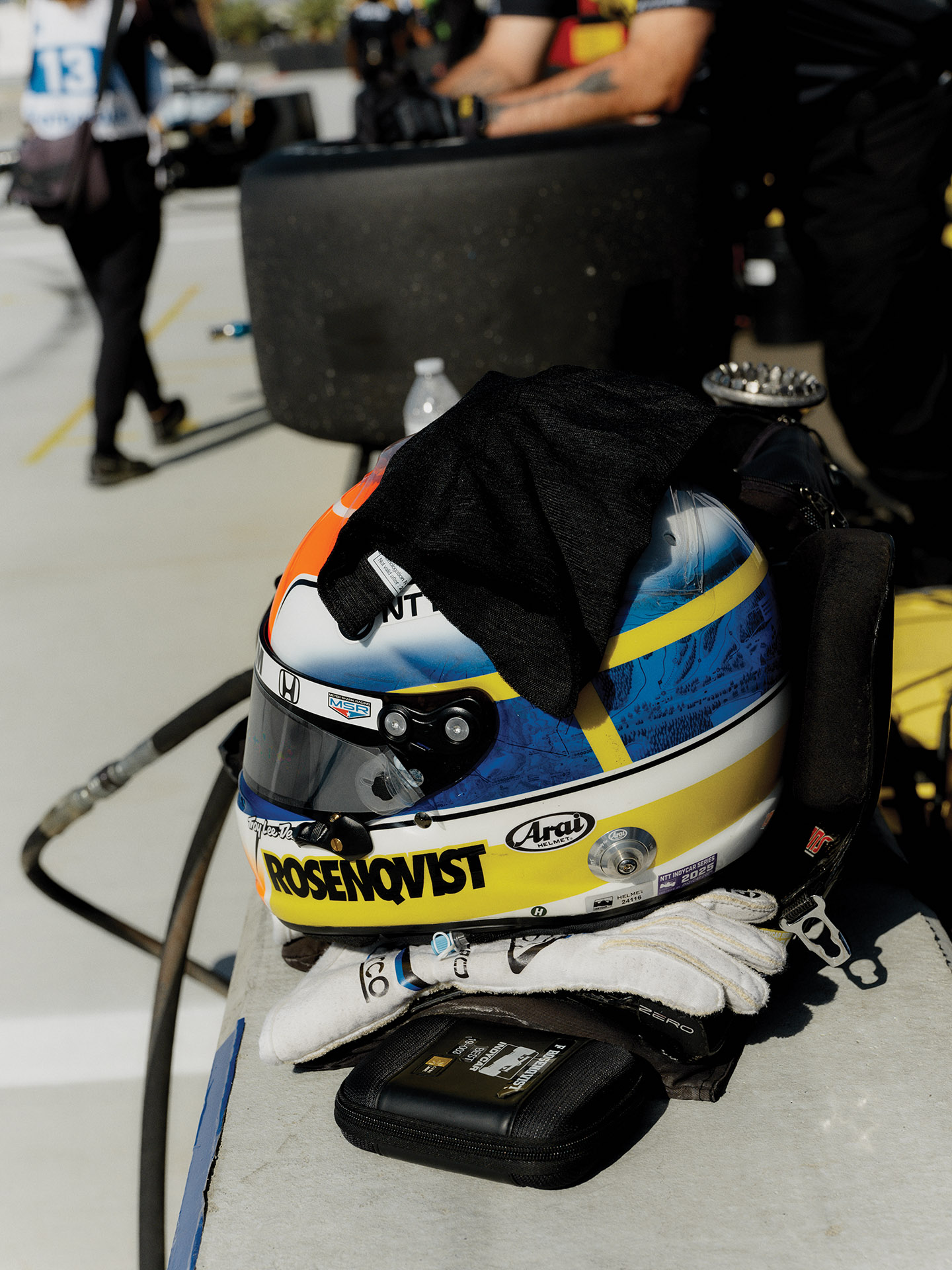
A closer look at Rosenqvist’s helmet.
The Barcelona native’s wizardry suggests the painter Joan Miró in a racing costume. No one can figure out his dot-to-dot style. On the road to Thermal, he’d won the season opener March 3 at St. Petersburg, Florida. As of press time, he’s won 16 races in 88 career starts, including the Indy 500 in May, and he sits comfortably at the top of driver standings, on his way to securing his fourth IndyCar championship.
Yet, like other drivers surveyed, Palou blanked on the topic of Palm Springs’ motorsports heritage: “Honestly, I don’t know much apart from great weather, nice golf courses.”
From 1950 to 1961, the Palm Springs Road Races ran 17 times at the airport. In the spring race of 1958 — attended by more than 23,000 spectators — Carroll Shelby, in a Maserati, led the middle laps over the 2.9-mile course. Stalking him in what The Desert Sun called “a blistering duel,” Riverside native Dan Gurney — behind the wheel of a Ferrari on his own 27th birthday — got by Shelby with five to go, taking the win. Gurney was fêted at the Chi Chi supper club, sitting with bandleader Paul Whiteman and their dates.
The Palm Springs Vintage Grand Prix revived the motorsports tradition from 1985 to 1996. Legends including 1961 Formula 1 champion Phil Hill, of Santa Monica, twisted through a seven-turn, 1.1-mile downtown course.
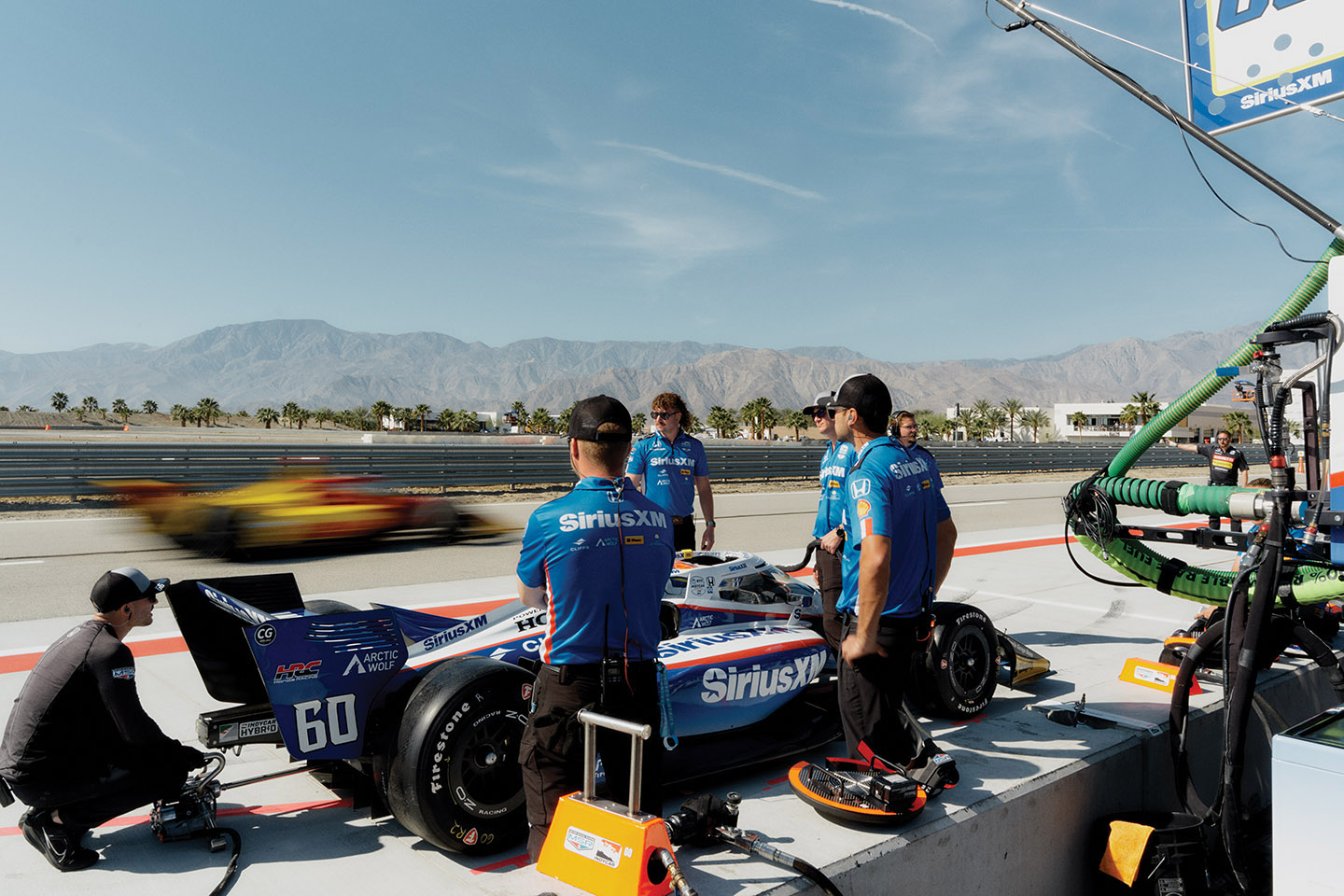
For last year’s IndyCar exhibition race, The Thermal Club admitted 2,000 ticketholders. This year, ESPN reported “3,000-ish” who scooped up general admission tickets for $450 each and VIP for $1,700 to $2,500. Tim Rogers, owner of The Thermal Club, said a key modification to the track was the $400,000 expansion of pit lane to accommodate all 27 entries.
Among spectators, many youngsters wore Patricio “Pato” O’Ward jerseys. Anthony Timo, 11, of Palm Desert, who stood in line with his family during the prerace autograph session, explained that his fandom dated from the docuseries, 100 Days to Indy.
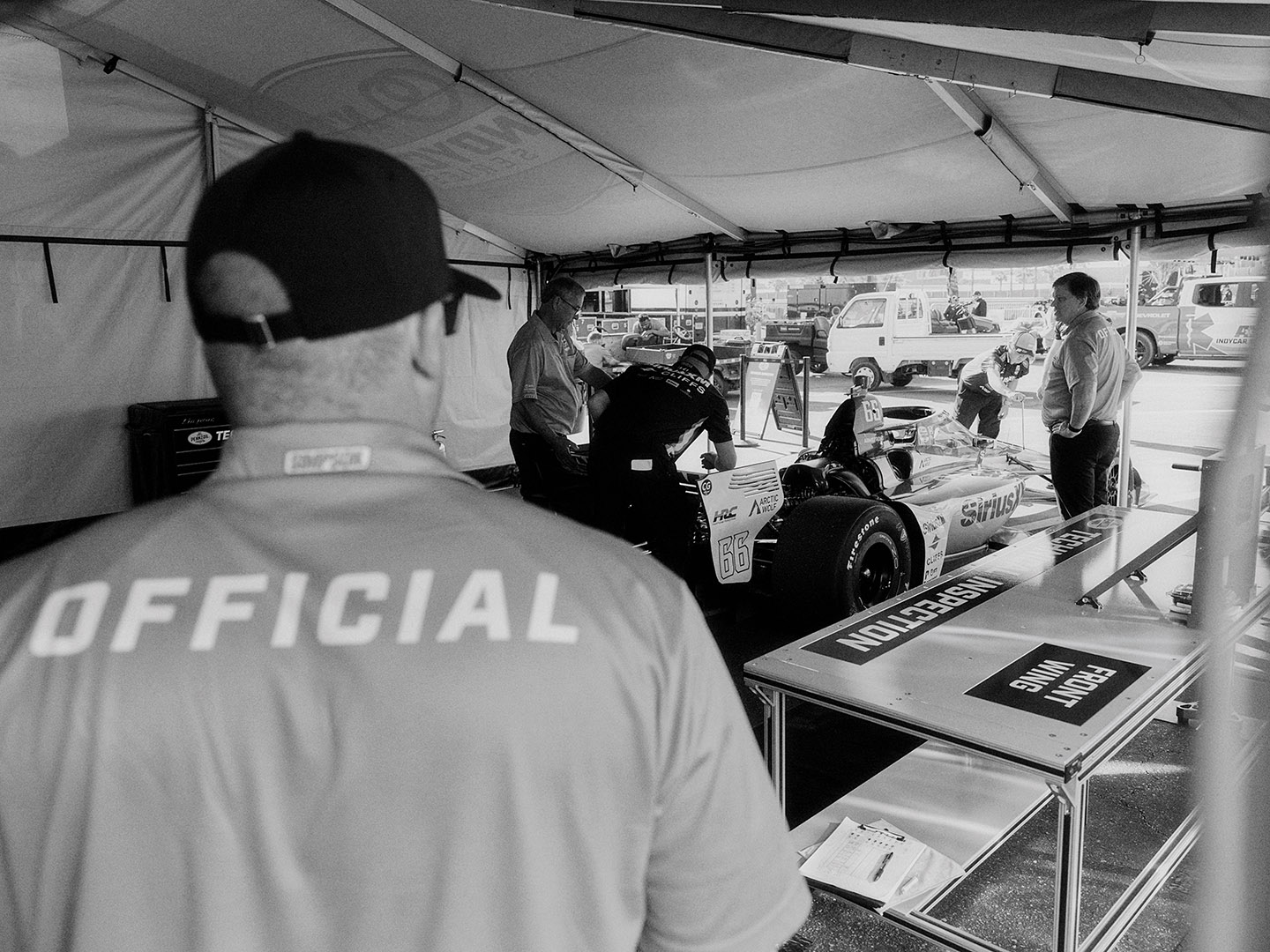
Marcus Armstrong’s Meyer Shank Racing entry rolls through the technical inspection tent.
“In my opinion,” young Timo said, “he’s the best driver by a lot — and the funniest!”
Claiming pole position during qualifying, O’Ward clocked a lap of 1 minute 39.9 seconds (110.4 miles per hour) in his Dallara-Chevrolet. Arrow McLaren teammate Christian Lundgaard, the gaunt, brooding Dane, came in at 1:40.1 to start second. Palou, at 1:40.3, sat third in his Chip Ganassi Racing Dallara-Honda.
Other notables gridding in the top 10 were a pair of affable Swedes with parallel careers. Marcus Ericsson, 34, winner of the 2022 Indianapolis 500, flew in early for a publicity appearance at a casino, then enjoyed dining in Palm Springs. Felix Rosenqvist, 33, winner of a 10-lap qualifying heat here last year, spoke favorably of Thermal in a midweek phone interview. “I thought it was a perfect track for an Indy car,” he said. “It has every type of corner, is pretty wide, and the long lap [17 turns over 3.067 miles] is cool.”
Sunday morning, the sky sizzled with Gulfstreams bearing racing fans into Jacqueline Cochran Regional Airport, just to the north of The Thermal Club. Then the air traffic ceased, and everybody settled into their VIP experiences. Fox broadcasters took a final check to make sure they were camera-ready.
With the wave of the green flag, O’Ward, Lundgaard, and Palou swept away in the first three places. Ericsson soon went offline and dropped to 12th. The race proceeded without any crashes to prompt a yellow caution flag, so the order remained fixed through the first pit stops for fuel and new tires, starting on lap 16. Ericsson returned to the course after pitting, burned a turn, and slid off. He dropped to 21st and struggled the rest of the way with too much desert on his sticky rubber.
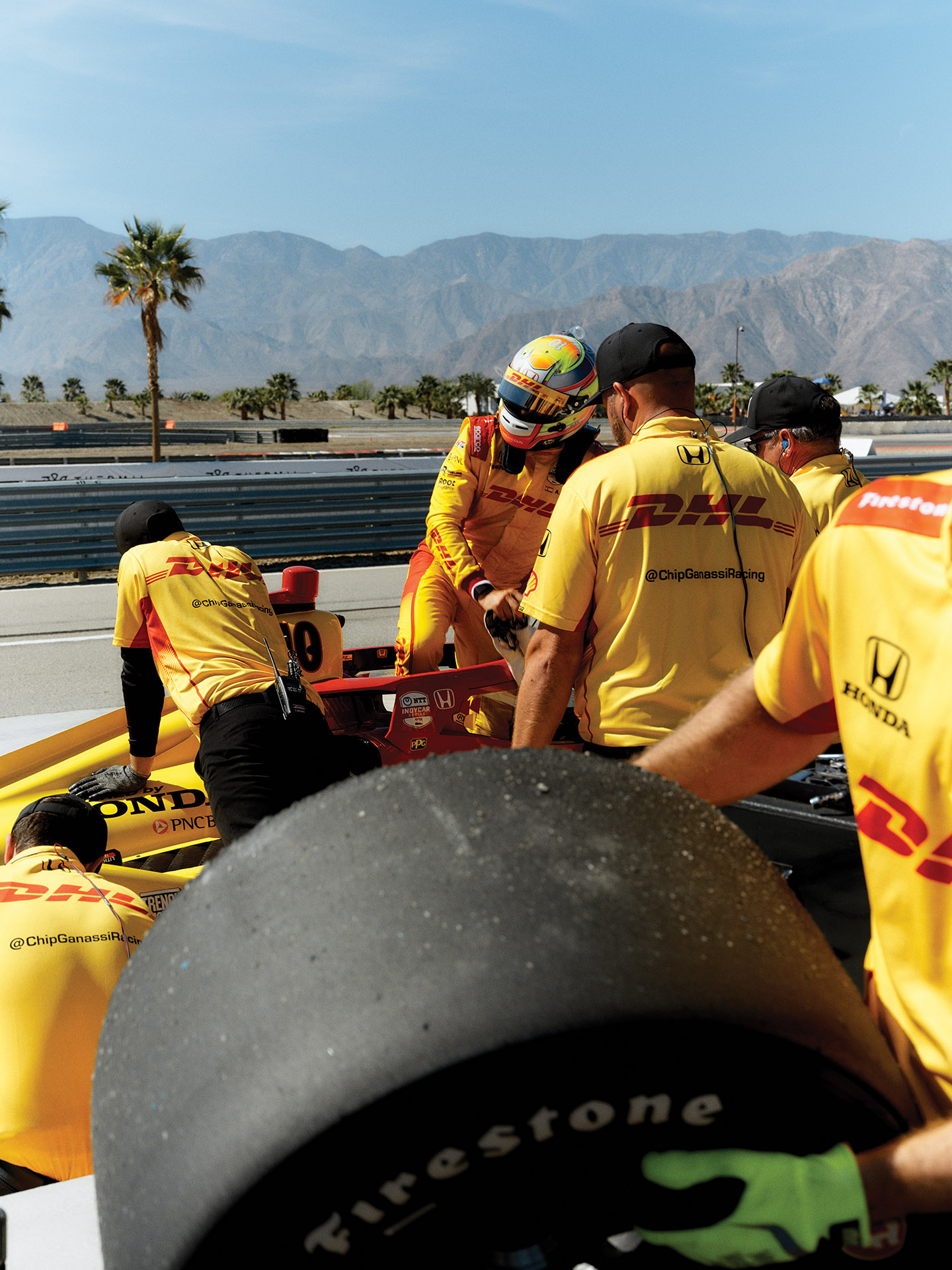
Álex Palou of Chip Ganassi Racing emerges from his race-winning machine.
O’Ward dominated through his lap 36 pit stop and beyond. Last call for fuel and Firestones came at lap 49 — and Palou must have put on Salvador Dalí’s cape, too. He returned to the course and soon passed Lundgaard for second in a nervy pas de deux.
“Palou is head down and charging,” broadcaster Will Buxton barked. O’Ward had a 10-second lead, but his tires were cooked. Palou chased down Pato like a wayward duckling, charging past him on lap 55, and sailing through the final 10 laps to the checkers.
Rosenqvist finished fifth, a fine result for Meyer Shank Racing. Ericsson’s day to forget kept him mired in 21st.
For O’Ward and Lundgaard, the agony of defeat meant hiding their misery while receiving smart-looking second- and third-place trophies. In the media center for a painful Q&A, O’Ward removed his cap and looked underneath as if to find the clue to defeat. Lundgaard kept his responses brief and sotto voce. If anyone, he resembled Peter Sidenius, the miserable protagonist of the Danish novel A Fortunate Man. (Watch Bille August’s film version.)
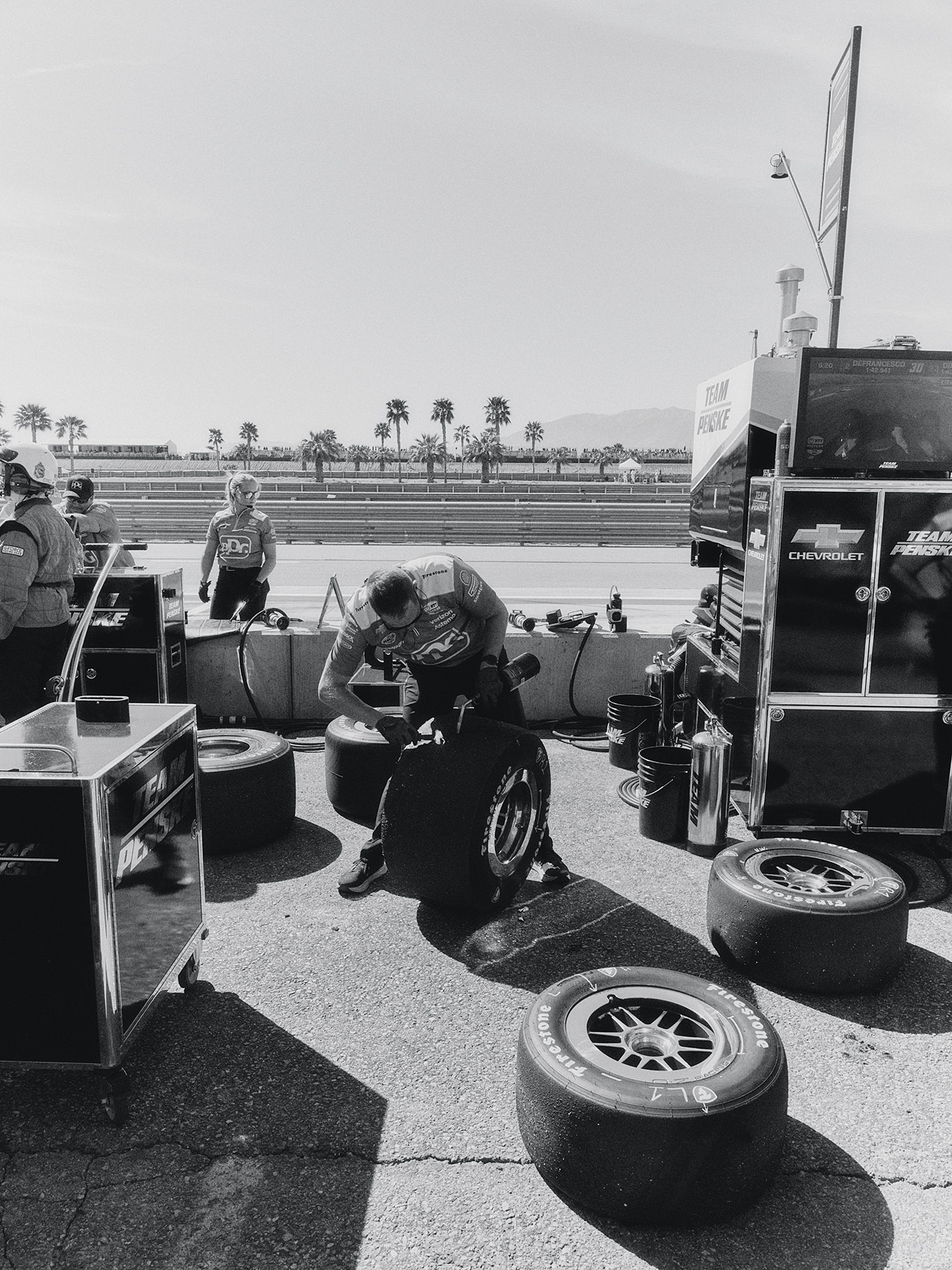
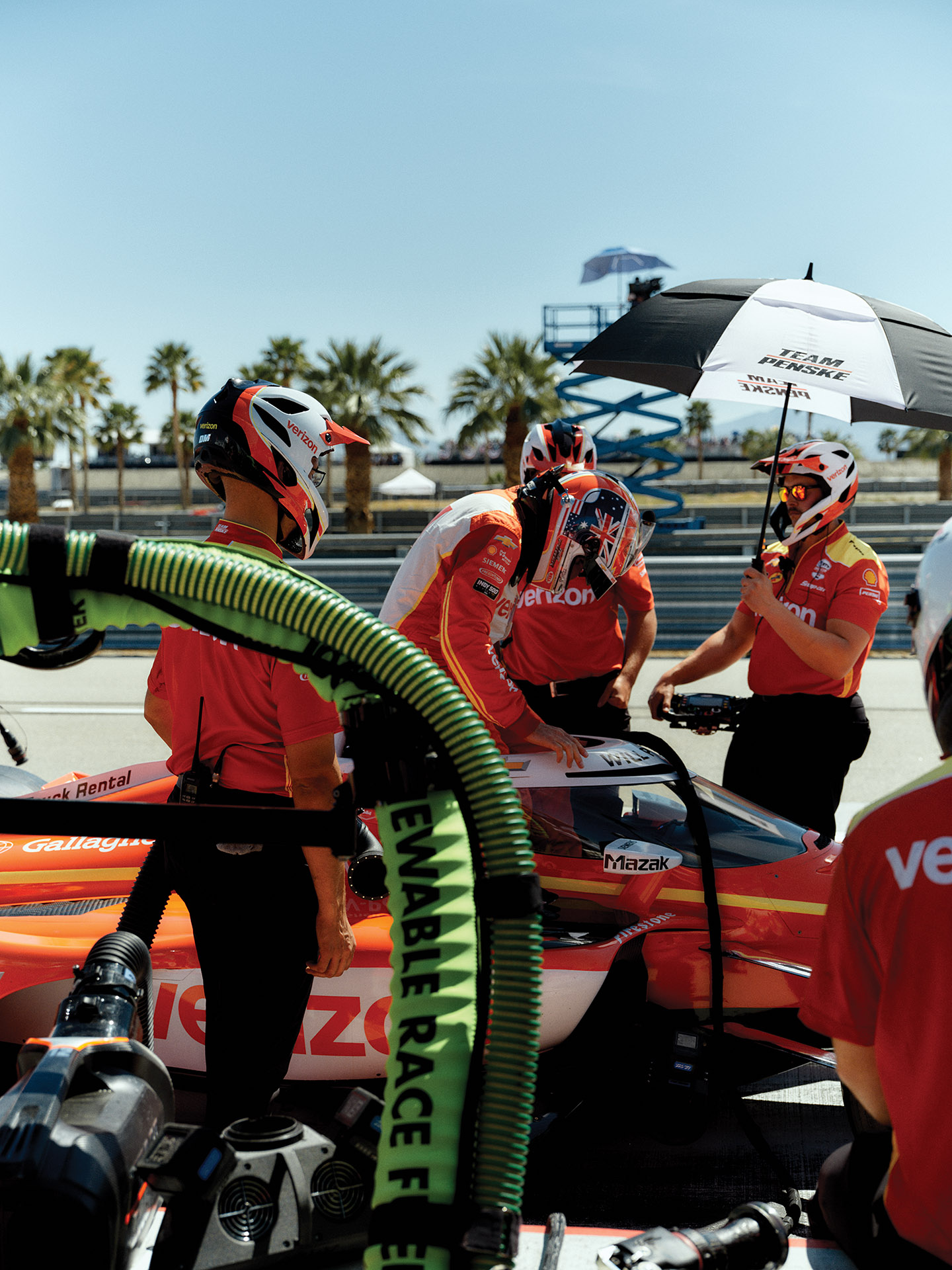
Tire time with Team Penske.
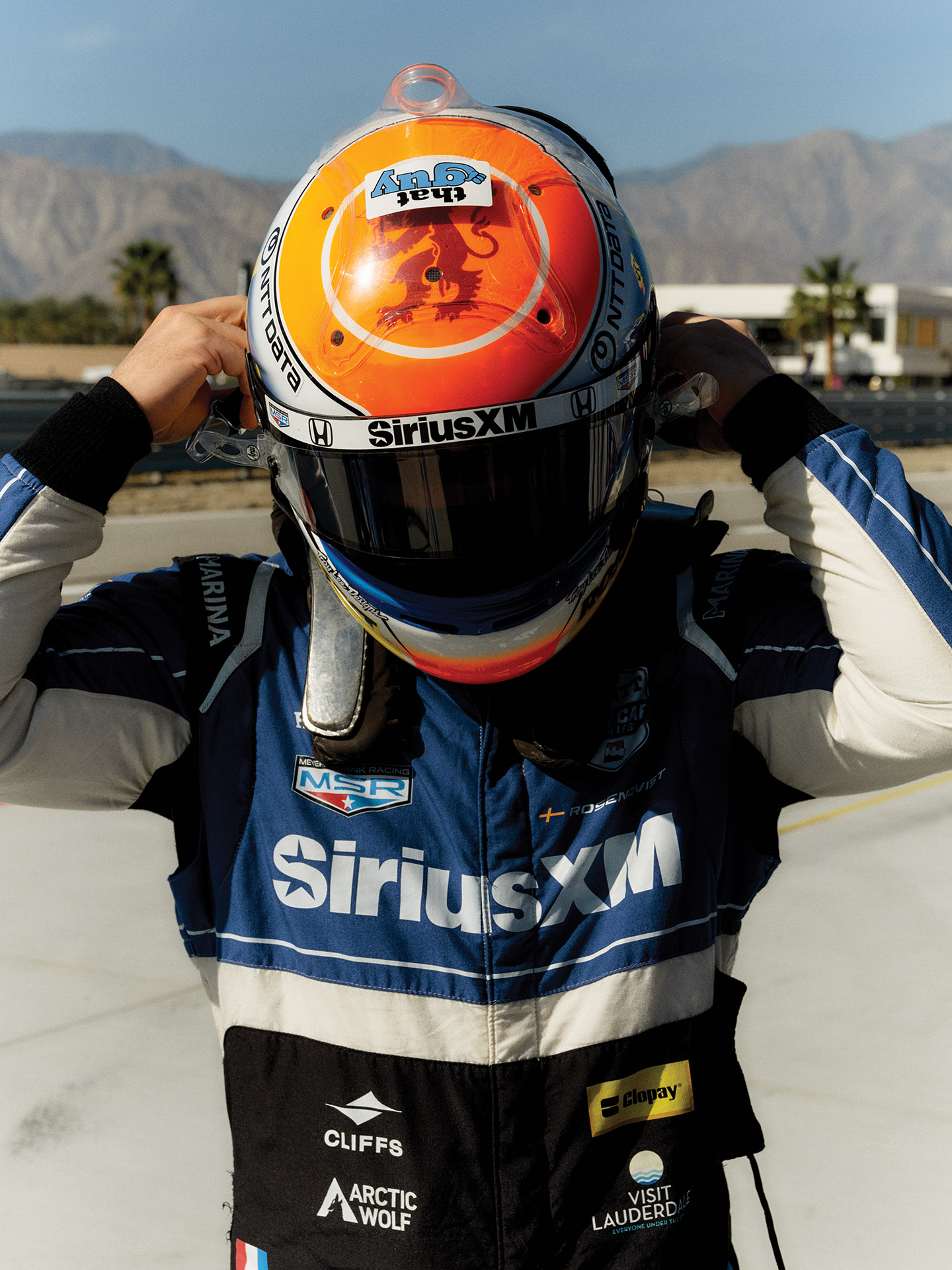
Rosenqvist suits up.
“It’s great to be part of the winners list in Palm Springs. Hopefully, we can do it again in the future.”
— Álex Palou, three-time NTT IndyCar Series champion and winner of the 2025 Thermal Grand Prix
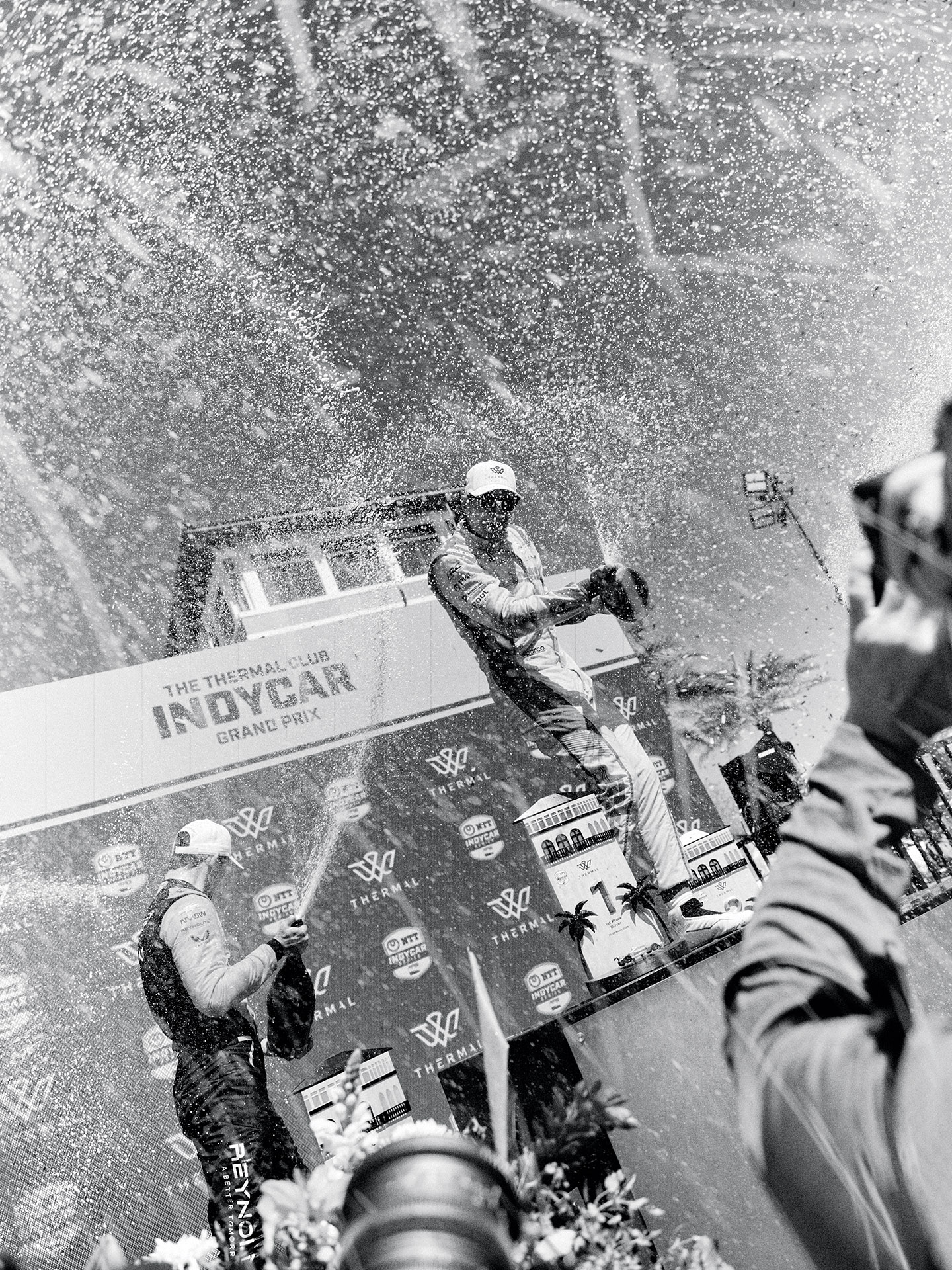
Palou lets the Champagne fly.
Will Power gets situated; he placed sixth.
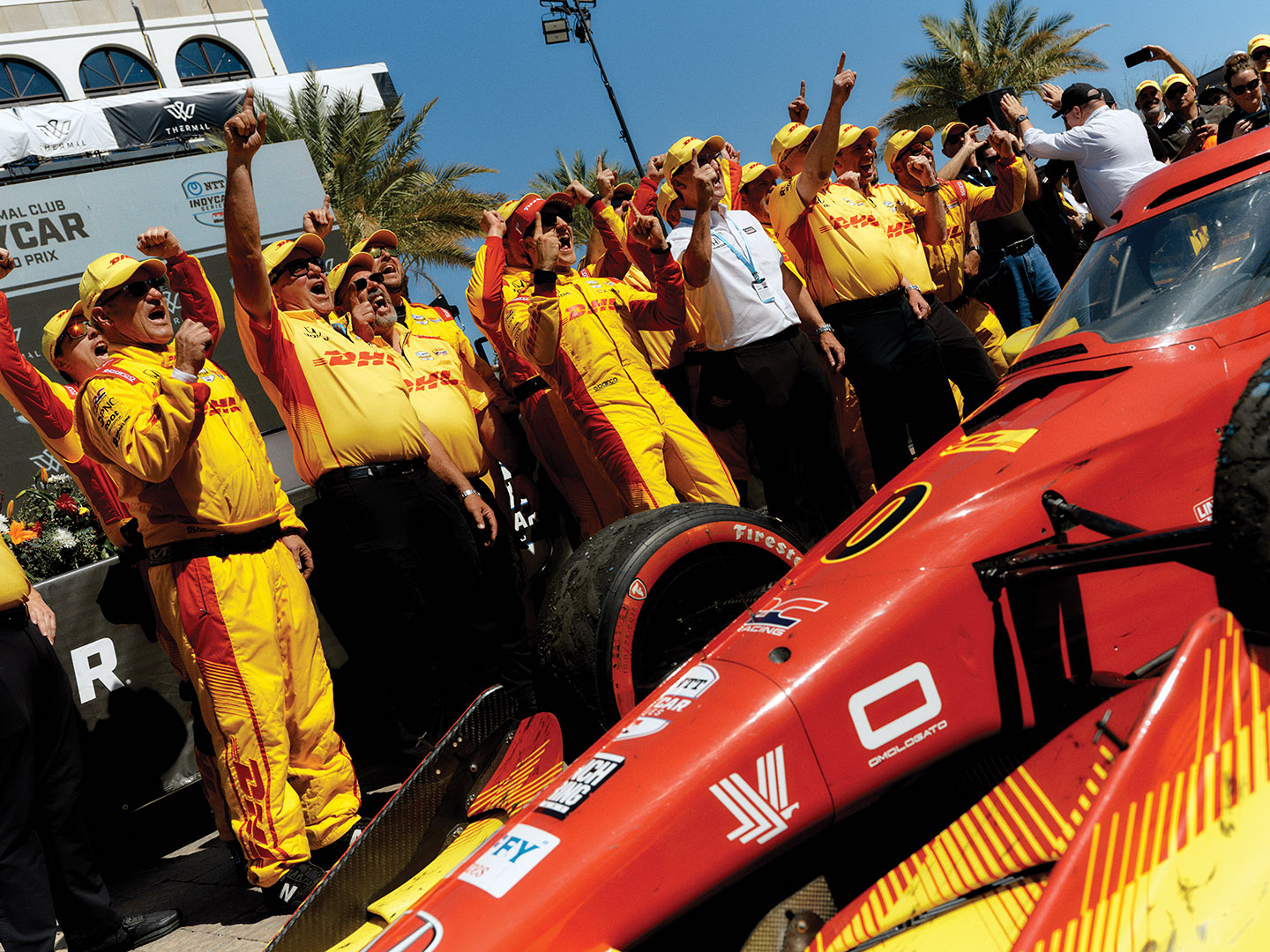
Chip Ganassi Racing cheers Palou’s win.
Palou, of course, exulted during postrace interviews. “It’s cool to race here,” he said. “It’s been really good for IndyCar, I believe. I don’t know if the race was fun or not to watch, but it was fun to drive.” Prompted on the motorsport heritage issue, he continued. “It’s great to be part of the winners list around here in Palm Springs. Hopefully, we can do it again in the future.”
Days before coming to Thermal, the NTT IndyCar Series confirmed a 2026 street race around the Dallas Cowboys’ stadium in a hosanna to suburbia, likely snatching away the mid-March calendar spot. Thermal’s angle for remaining on the schedule was the offer of a new 4.2-mile track configuration, which would surpass Road America in Wisconsin as IndyCar’s longest. At press time, Tim Rogers had a disappointing outlook on IndyCar’s contract renewal and return: “I would say no,” he shared.
Turns out, the most exclusive stop on the schedule may also have been the most short-lived.