The desert will harbor one less secret when Modernism Week 2026 sweeps in next month: La Quinta Country Club will finally unlock its long-impenetrable gates for public tours of six private residences. Until now, only flashes of the architectural gems inside Golf Estates — the largest of the 13 tracts orbiting the club — have drifted into the collective consciousness. One of the most whispered-about is the 1960 A. Quincy Jones and Frederick Emmons house designed for film director Frank Capra, an outwardly modest hideaway with a loyal fan base. (Spoiler alert: It’s not on the tour. But you won’t miss it.)
At long last, La Quinta Country Club’s modernist pedigree is coming into view. The debut event, organized by Golf Estates homeowner Robert Millar, effectively answers a challenge from Modernism Week CEO Lisa Vossler Smith. “When I asked her why the organization had never featured modernism in La Quinta,” Millar recalls of their conversation at a January 2025 event, “she lowered her glasses to the tip of her nose and said, ‘Because, Robert, nobody’s ever volunteered to make it happen.’ ”
A small footnote before we continue: Linda Williams, president of La Quinta Historical Society, attempted to organize a home tour in 2018, writing letters to homeowners in hopes of sparking both participation and architectural documentation. If heritage design exists in a vacuum, preservation can’t flex.
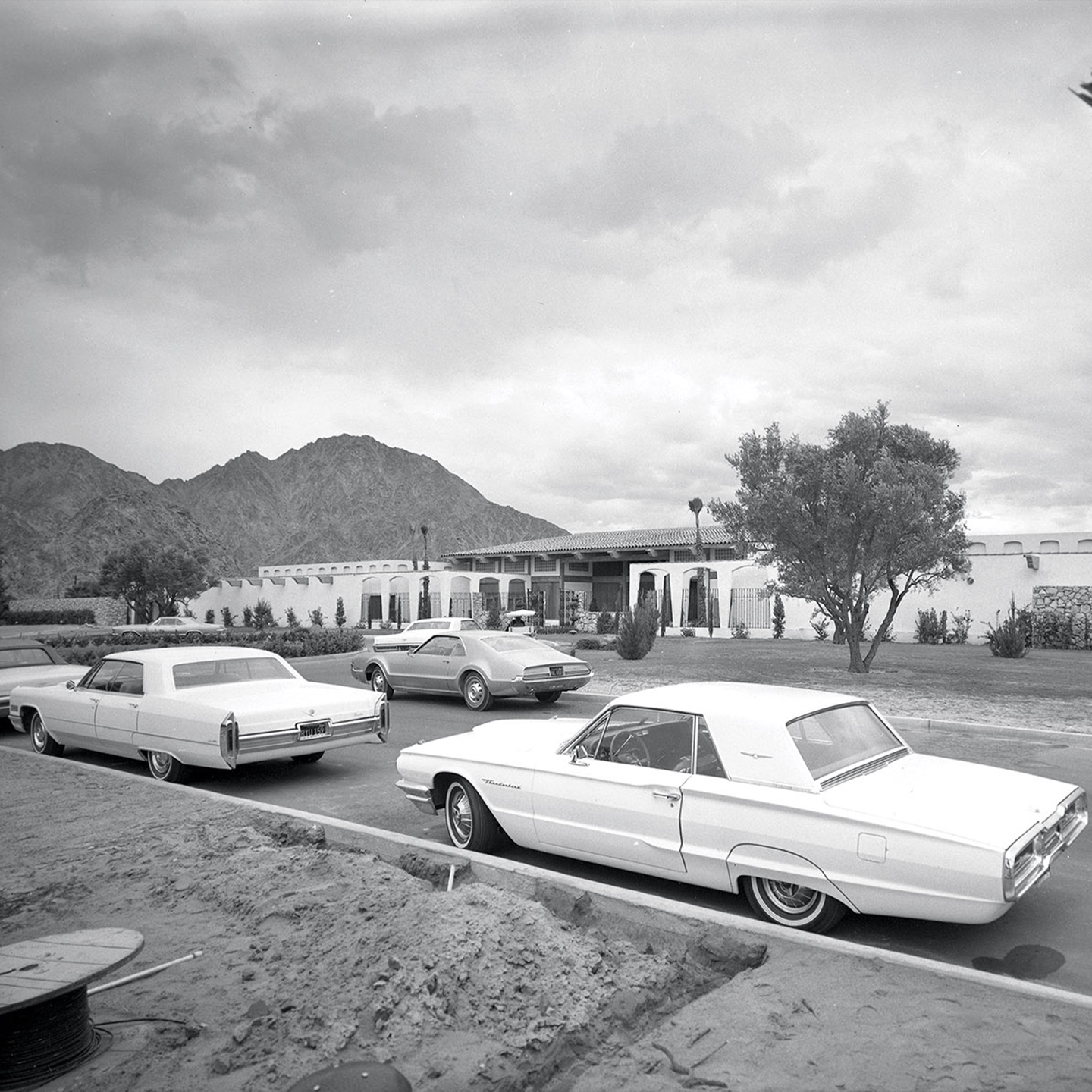
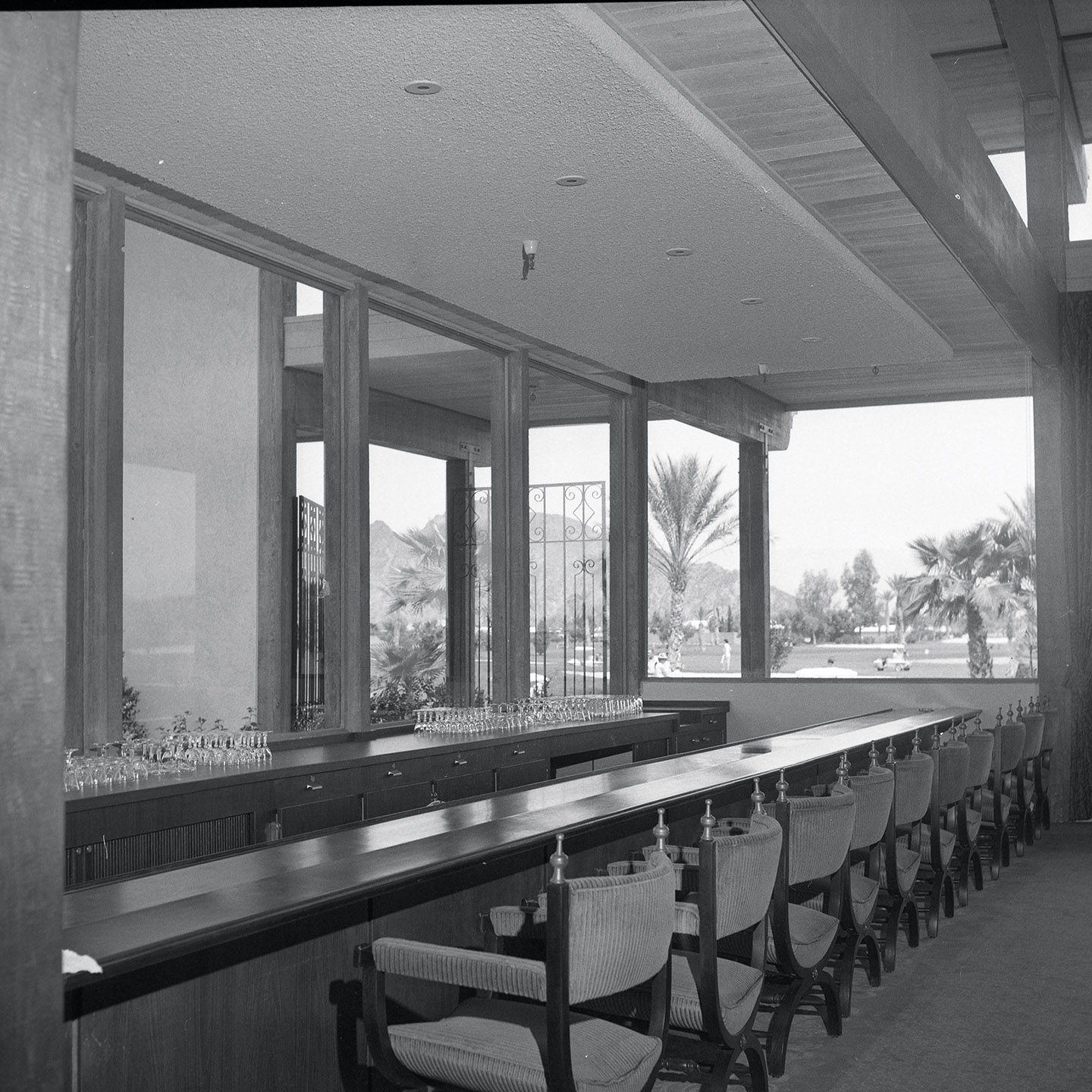
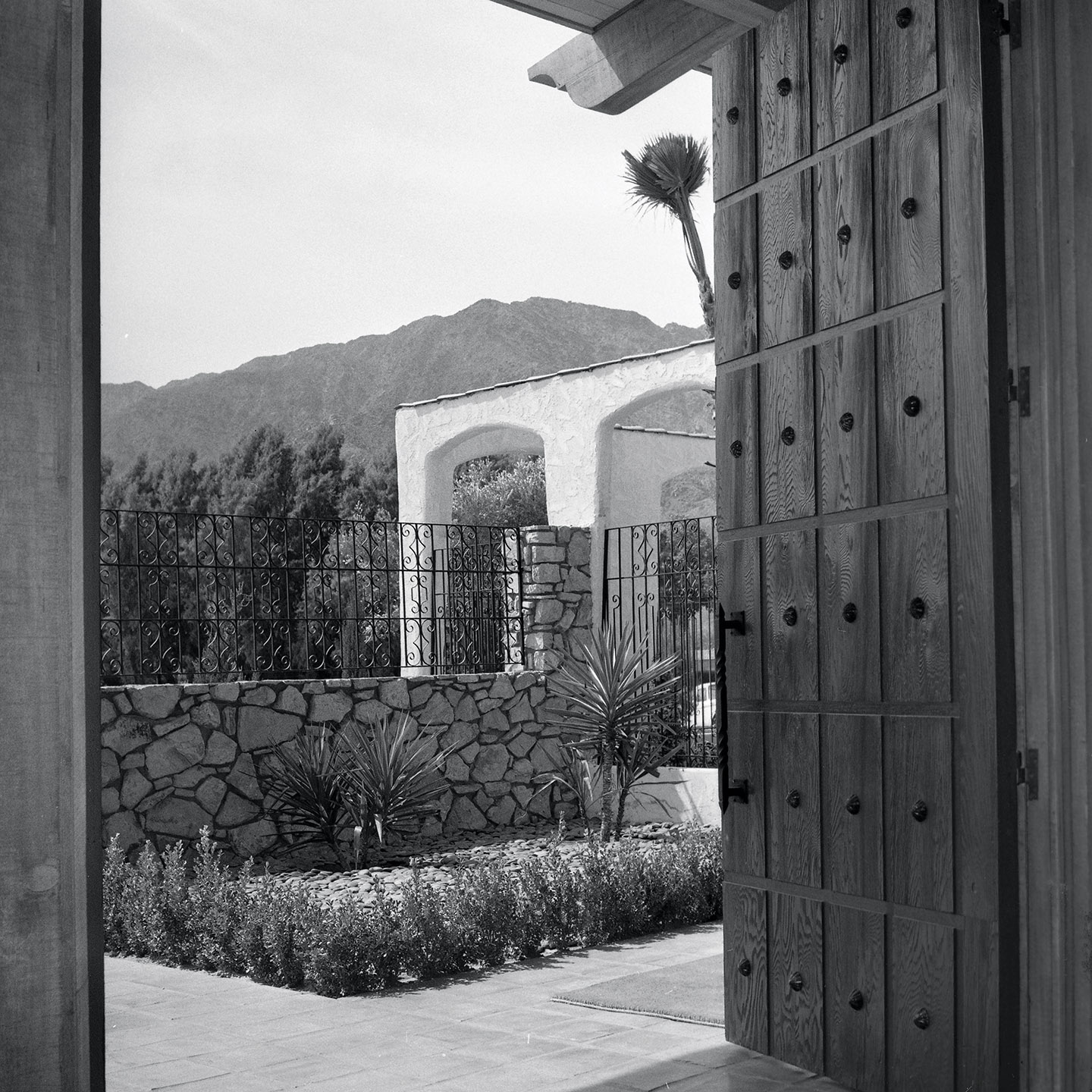
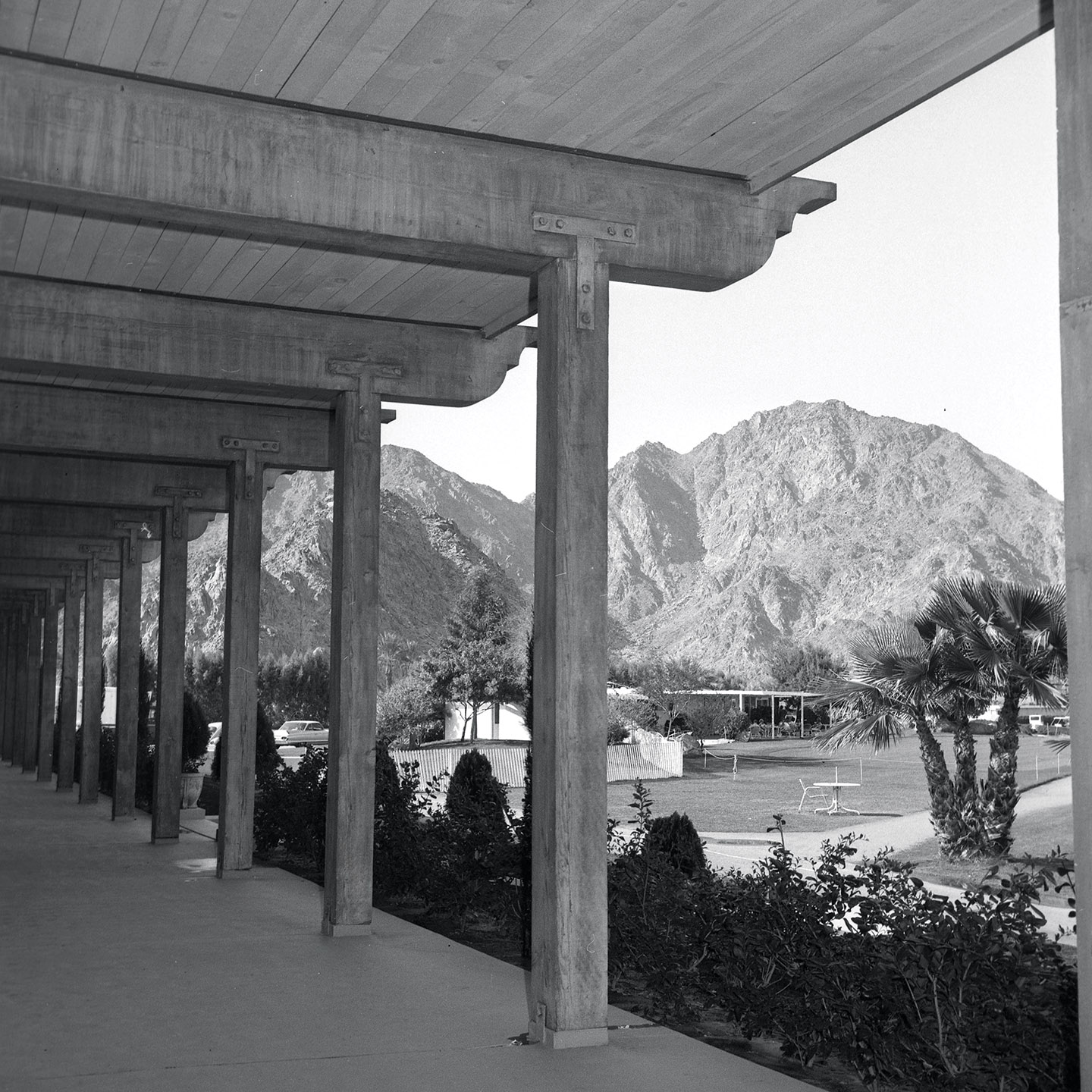
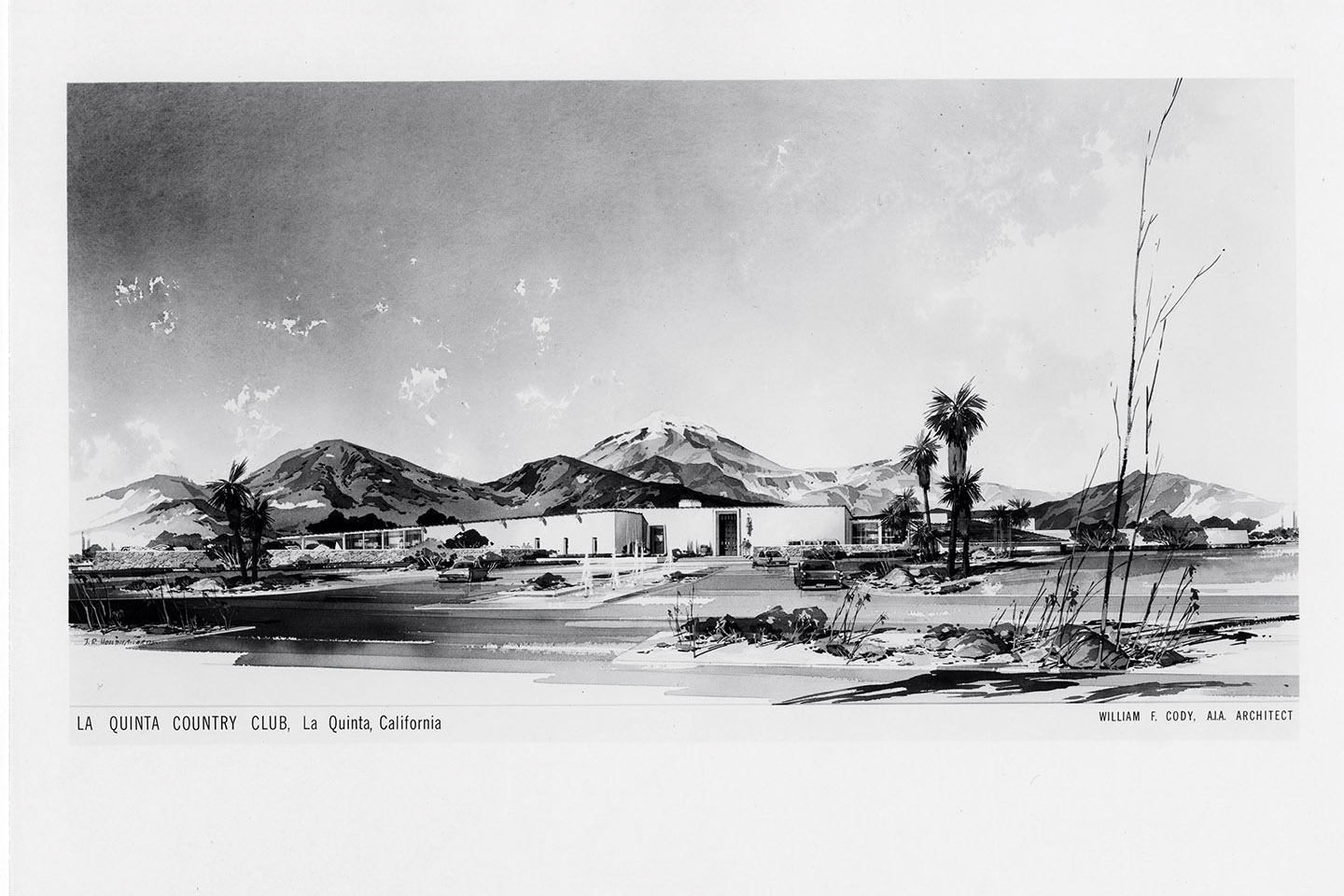
Early clubhouse concepts by William F. Cody, Hugh Kaptur, and William Krisel (Cody’s shown above) gave way to Los Angeles–based architect Jack Lawrence White’s Mediterranean design for the 1966 clubhouse: whitewashed stucco, red-tile roofs, carved doors, and timber-trussed ceilings.
Photographs courtesy palm springs life archives
“I talked to one neighbor who owns an original William Cody, and she didn’t even know [of its provenance],” Millar says, still alarmed. In that light, a home tour is less spectacle than scaffolding, a way to build awareness to a meaningful end. “It took someone from the inside — an actual neighbor — to make it happen,” Williams says.
That appetite for privacy may explain why desert modernism remains, at least in the zeitgeist, a Palm Springs story. But La Quinta was shaping a parallel legacy beginning in 1926, when architect Gordon Kaufmann gave travelers like Greta Garbo, Clark Gable, and Katharine Hepburn a taste of desert glamour with the La Quinta Hotel, a Spanish Colonial Revival mirage set among date and citrus groves at the foot of the Santa Rosa Mountains.
Three decades later, Chicago attorney Leonard Ettleson and his merry band of investors bought the hotel and more than 1,000 acres of surrounding farmland, envisioning a golf community that would extend the resort’s reach and reputation. In 1958, approximately 130 acres were parceled from that pie for what became La Quinta Country Club. Developers tapped Cody, Hugh Kaptur, and William Krisel for clubhouse concepts, but the final commission went to Los Angeles architect Jack Lawrence White.
In 1966, a temporary clubhouse — affectionately called “The Shack” — gave way to White’s Mediterranean design: whitewashed stucco, red-tile roofs, tall carved doors and iron balustrades, and 20-foot timber-trussed ceilings nodding to the romance of Kaufmann’s historic hotel. Even a magnitude 5.6 earthquake in 2005 couldn’t shake that identity; when the damaged clubhouse was rebuilt in 2009, it held fast to its architectural roots, right down to the arched colonnades and terracotta flourishes.
You could practically taste the icy martinis while watching golf balls sail through the air, poolside.
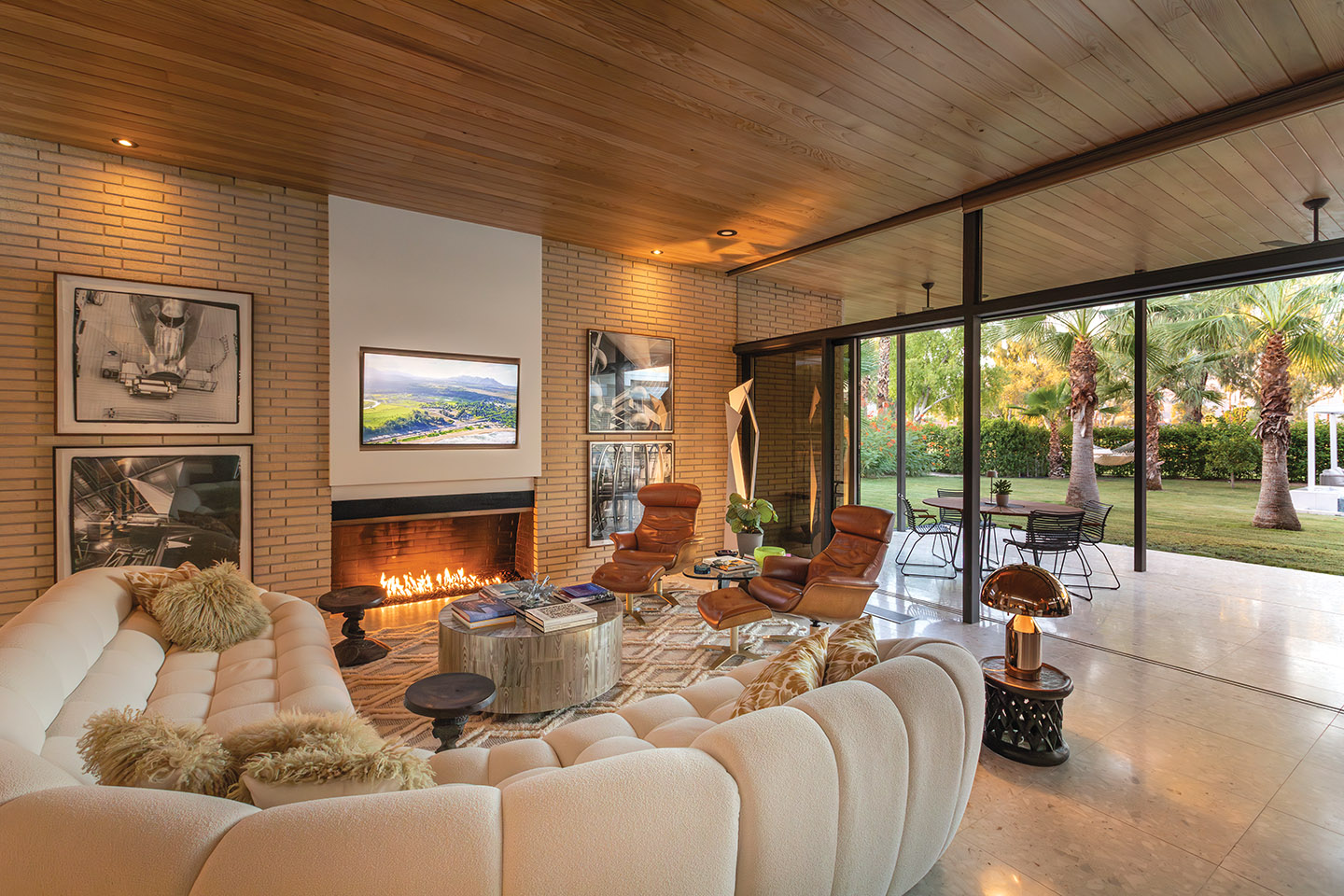
The living room highlights original midcentury bones in the stack-bond brick, terrazzo floors, and tongue-and-groove ceiling. The covered outdoor living space extends indoor-outdoor flow.
Photo by scott pasfield, courtesy Robert Andrew Millar & Associates
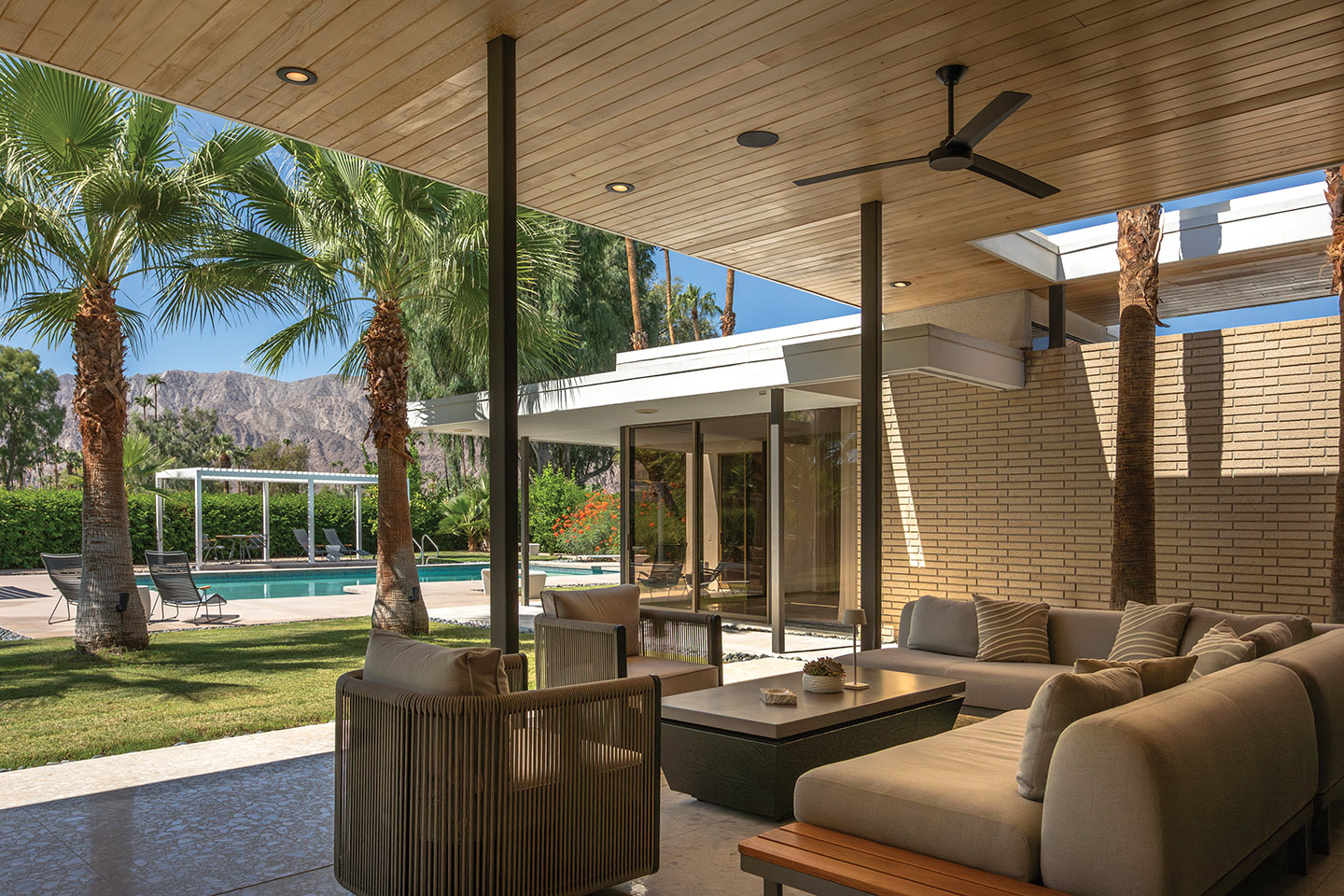
A gathering space for games leads to the bar and kitchen,
where clerestory windows and slender steel supports make the roof plane appear to float.
Photo by Scott Pasfield, courtesy Robert Andrew Millar & Associates
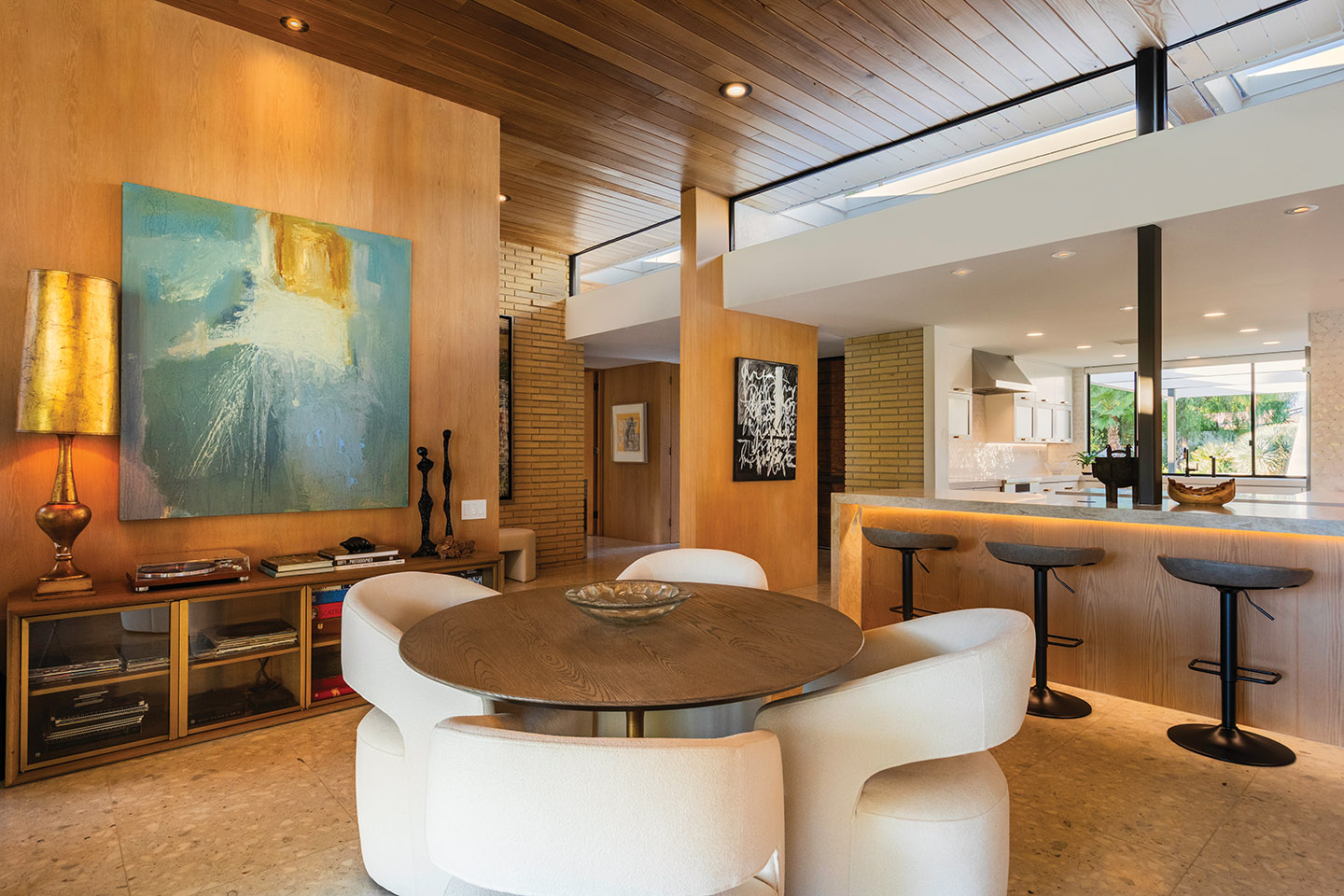
Robert Andrew Millar and Mario Guariso fell in love with this 1969 home by architect Robert Ricciardi.
Photo by Scott Pasfield, courtesy Robert Andrew Millar & Associates
In 1966, a temporary clubhouse — affectionately called “The Shack” — gave way to White’s Mediterranean design: whitewashed stucco, red-tile roofs, tall carved doors and iron balustrades, and 20-foot timber-trussed ceilings nodding to the romance of Kaufmann’s historic hotel. Even a magnitude 5.6 earthquake in 2005 couldn’t shake that identity; when the damaged clubhouse was rebuilt in 2009, it held fast to its architectural roots, right down to the arched colonnades and terracotta flourishes.
The course itself carries pedigree. Lawrence and Frank Hughes — the same brotherly duo behind the tour-tested turfs at Thunderbird, Tamarisk, and Eldorado — designed the spread at La Quinta Country Club. In October 1960, President Dwight D. Eisenhower christened La Quinta’s first course (there are now more than two dozen in the city) by hitting an 8-iron straight down the fairway. For many years, his brother Edgar was believed to have kept a home “on campus.”
That’s collegiate jargon used by Catherine Krell, who works in marketing at the club, to describe the satellite neighborhoods occupying the remaining acreage of Ettleson’s original holding. Bounded by Eisenhower Drive, Washington Street, and Avenue 50, this area contains about 475 houses across 13 tracts, including Country Club Estates (the original 1958 subdivision), Golf Estates (an architecturally significant cluster), and Montero (a 1970s ranch-style enclave).
La Quinta Country Club general manager and former golf pro Chris Gilley resists the idea of any formal campus. “There are HOAs around us whose residents can drive a golf cart onto our property, but we have no real connection aside from many of our 350 members living there,” he says. “Unlike clubs like Madison or Vintage, where homeownership is tied to the experience, we’re more of a mom-and-pop standalone.” That independence has roots: The club parted ways with La Quinta Hotel in 1977, when the members purchased it from the owners, solidifying an autonomous spirit decades in the making.
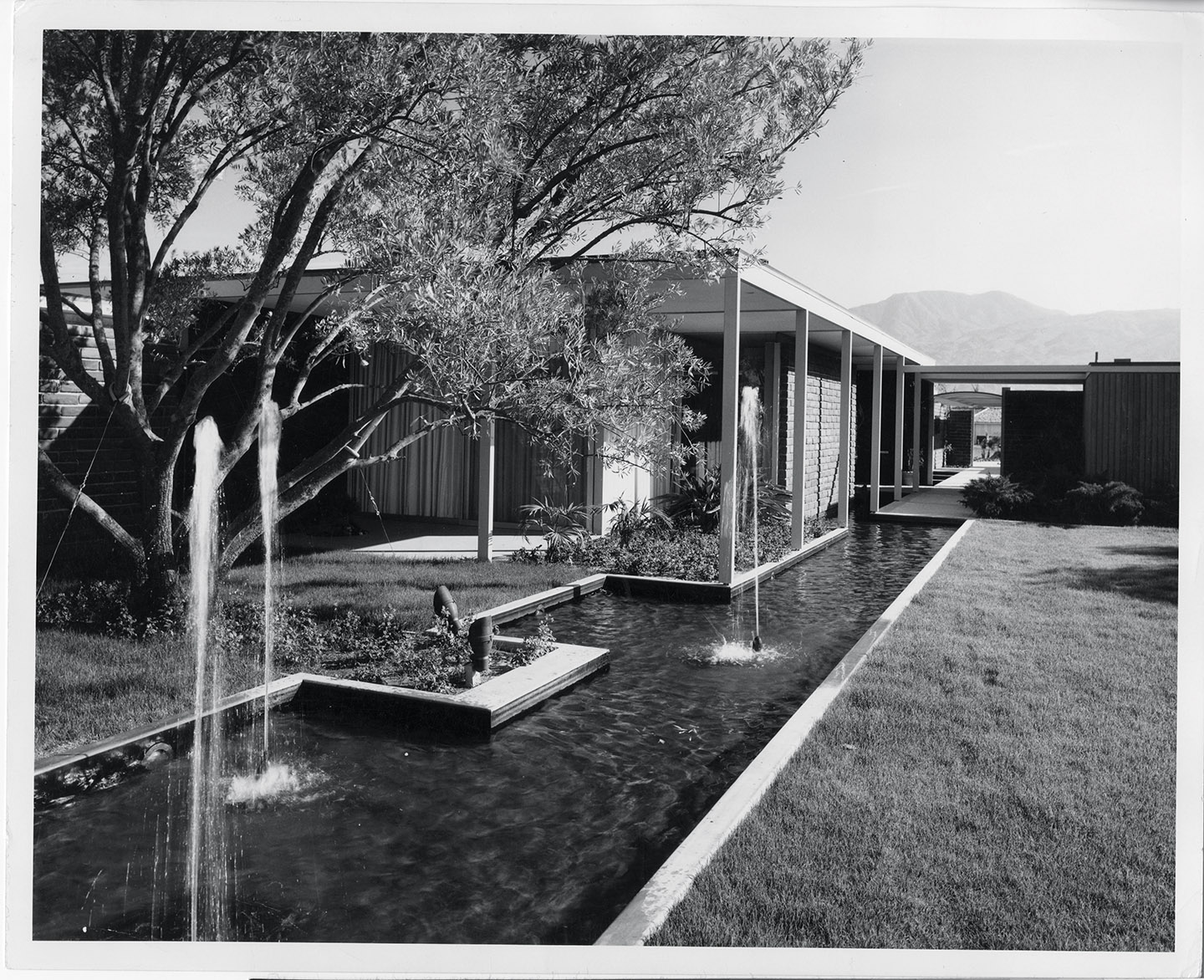
Photo courtesy William F. Cody Papers, California Polytechnic State University, San Luis Obispo
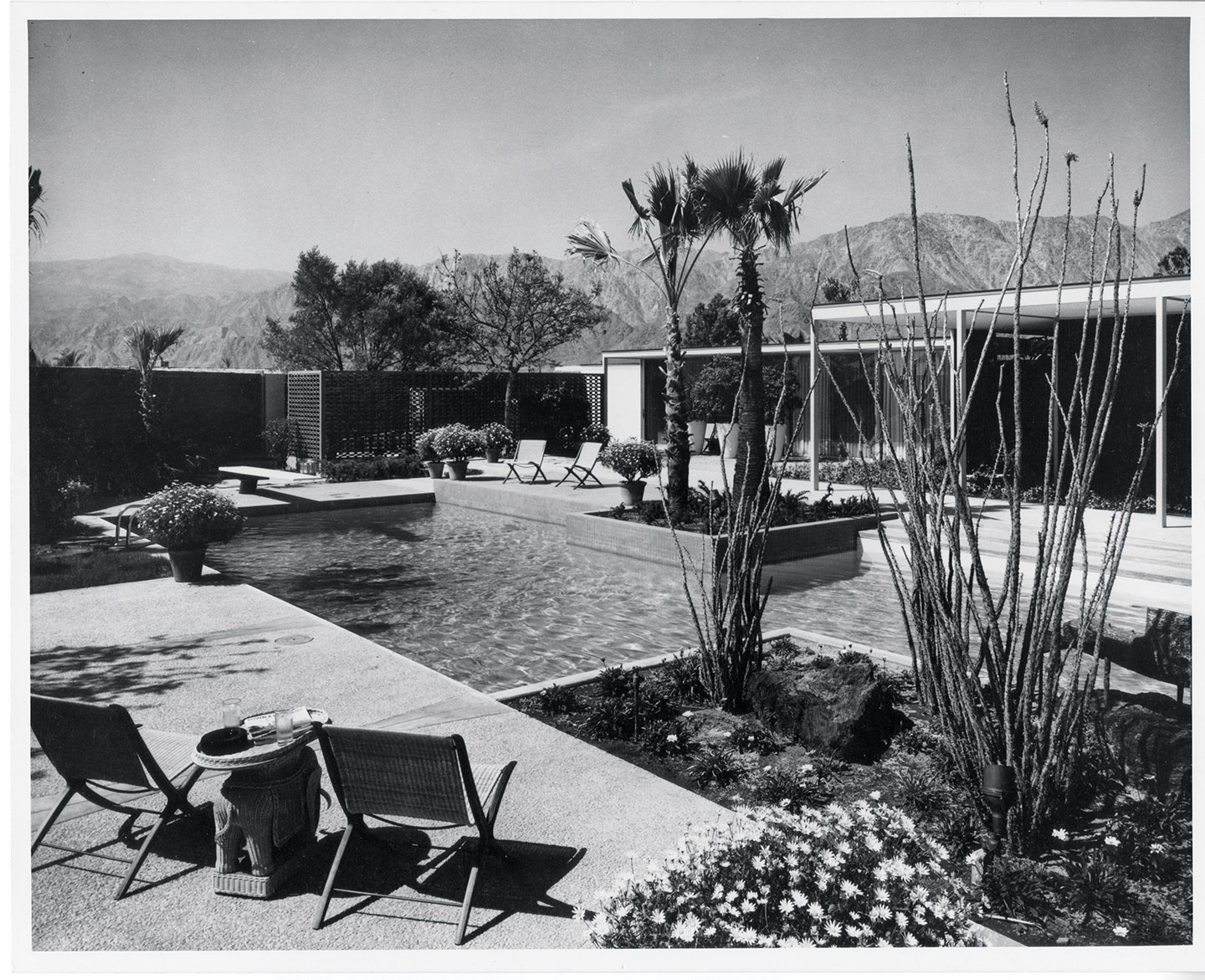
Photo courtesy William F. Cody Papers, California Polytechnic State University, San Luis Obispo
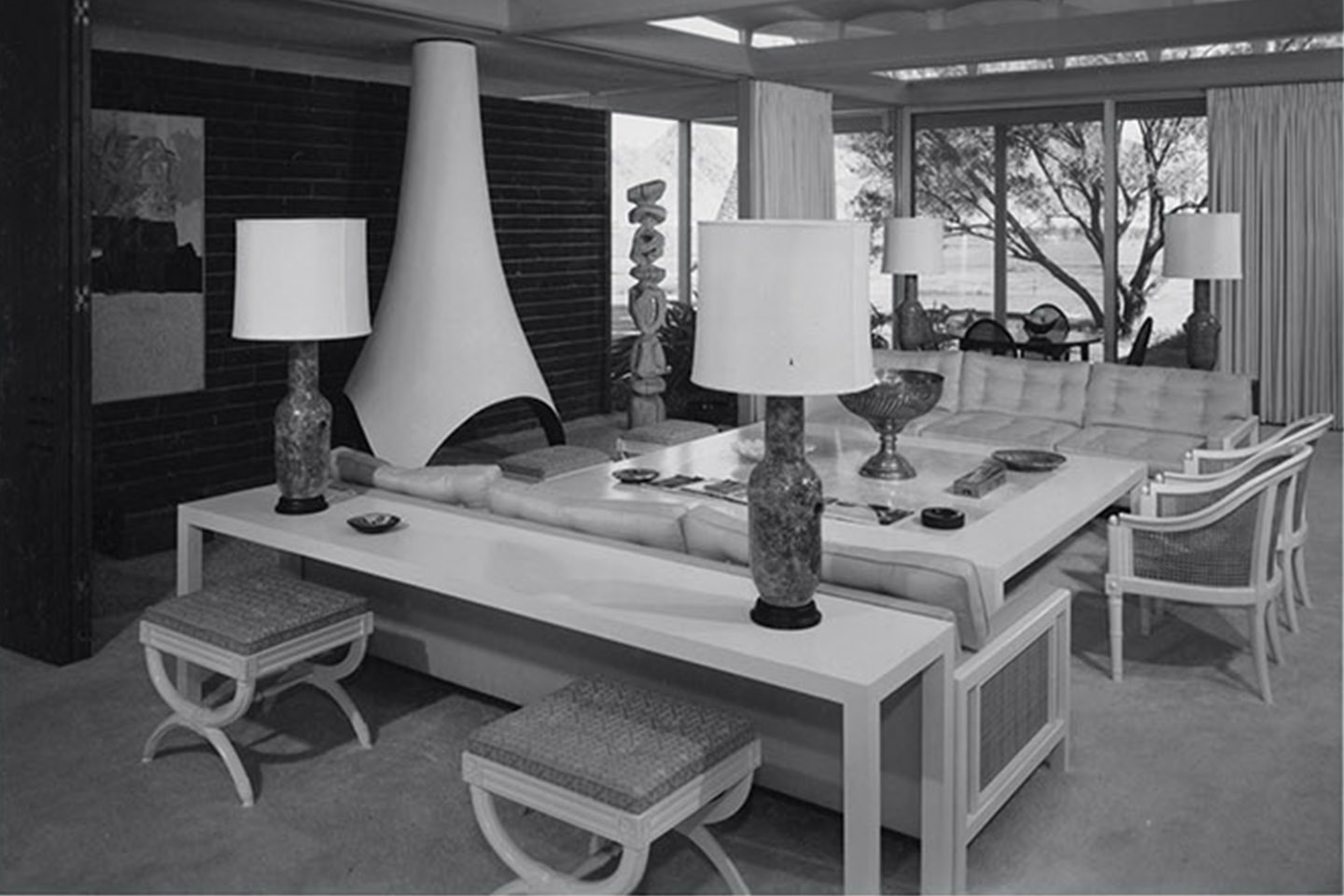
Photographs taken in 1962 show vignettes of the newly completed W. & J. Sloane House, designed by architect William F. Cody as a display home for the Sloane furniture company. It showcased high-end design and a quintessential desert way of life.
Photo courtesy William F. Cody Papers, California Polytechnic State University, San Luis Obispo
“We’ve always called this corner of La Quinta the best-kept secret in the Coachella Valley,” Krell says. She lives a stone’s throw from the Capra residence, which has fueled city lore for years. Tourgoers will likely get a bonus drive-by aboard the event’s official golf carts, glimpsing the director’s 4,221-square-foot retirement pad, where he and his wife, Lucille, lived until downsizing to a casita at the hotel around 1980.
A bit of imagination helps when passing the post-and-beam classic with a split personality: modest to the street, then dramatically opening to the fairway — privacy in front, party in back. Another Cody-designed Golf Estates showpiece — the 1961 W. & J. Sloane House, aka La Quinta Display House — pushed that idea further, serving as a model residence for the new tracts. The project offered a full Kodachrome picture of country club living. You could practically taste the icy martinis while watching golf balls sail through the air, poolside. It set the stage for the fairway flaunting to come in La Quinta.
“The whole idea of lining the greens with houses really started with Johnny Dawson, the developer at Thunderbird,” says historian Luke Leuschner, referencing the valley’s first private country club, established in 1951 in Rancho Mirage. “That’s where you get the concept of the country club home being closed off from the street, but open to these beautifully composed views of a pastoral landscape.”
At La Quinta Country Club, that means a plush “magic carpet” of Bermuda grass — overseeded with perennial rye and Poa trivialis, for the agronomists — with 84 bunkers, five lakes, and one heck of a cinematic backdrop of the Santa Rosas.
“It’s a beautiful tree-lined course with no trickery, no gimmick — just enjoyable to play every day,” Gilley says. For more than 50 years, the club has been part of the PGA Tour rotation, and pros are known to gush about the conditioning. Phil Mickelson once called the greens “the best on tour,” while Scottie Scheffler described them as “some of the best surfaces I’ve ever seen.” Comparisons to Augusta National are never far from earshot.
During the 1970s heyday of the Bob Hope Classic (now The American Express), the fairways glowed with their own constellation of tee-timing stars — Frank Sinatra, Dean Martin, Jack Benny, Jackie Gleason, and Andy Williams among them. The allure hasn’t faded: Gilley confirms that current members include comedian George Lopez and actor-director Clint Eastwood. Pop singer Justin Bieber has initiated the application process.
But we digress. The homes on these fairways exemplify Princeton architectural historian Beatriz Colomina’s observation that modern architecture negotiates the charged space between private retreat and public gaze. One stop on the Modernism Week tour — a 2023 house by Palm Springs architect Lance O’Donnell for Michael and Betty Terry of Orange County–based Graystone Custom Builders — pushes that tension into International-style territory. Horizontal planes hover over floor-to-ceiling glass; from the second story, the 11th fairway unfurls in full panorama. At ground level, a ficus screen turns spectacle into seclusion — privacy in the front and, in a plot twist, privacy in the back. “The ficus even reframes the mountains to be the show, not the golf,” Betty says.
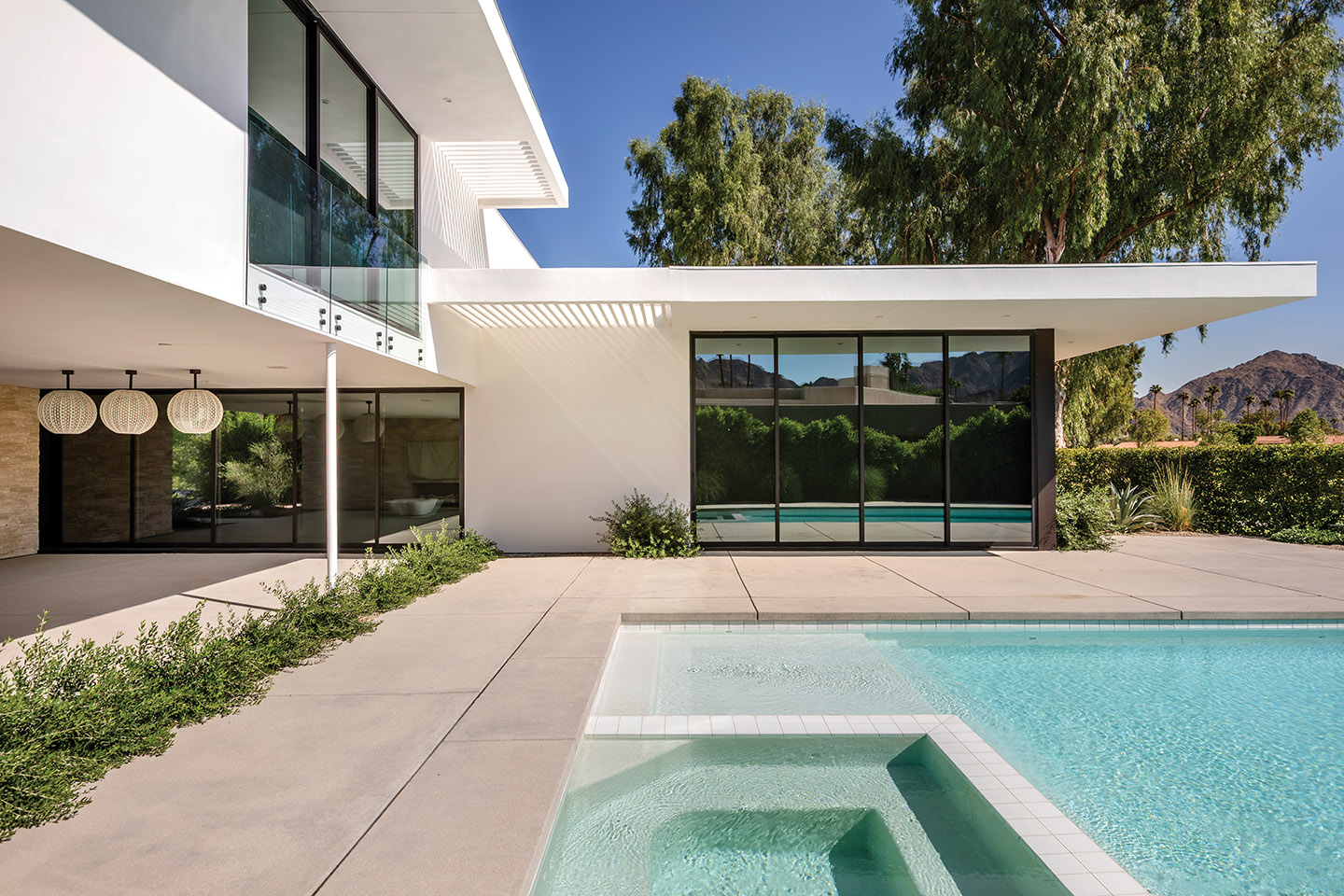
2023 home designed by Lance O’Donnell of O2 Architecture.
Photo by scott pasfield, courtesy Robert Andrew Millar & Associates
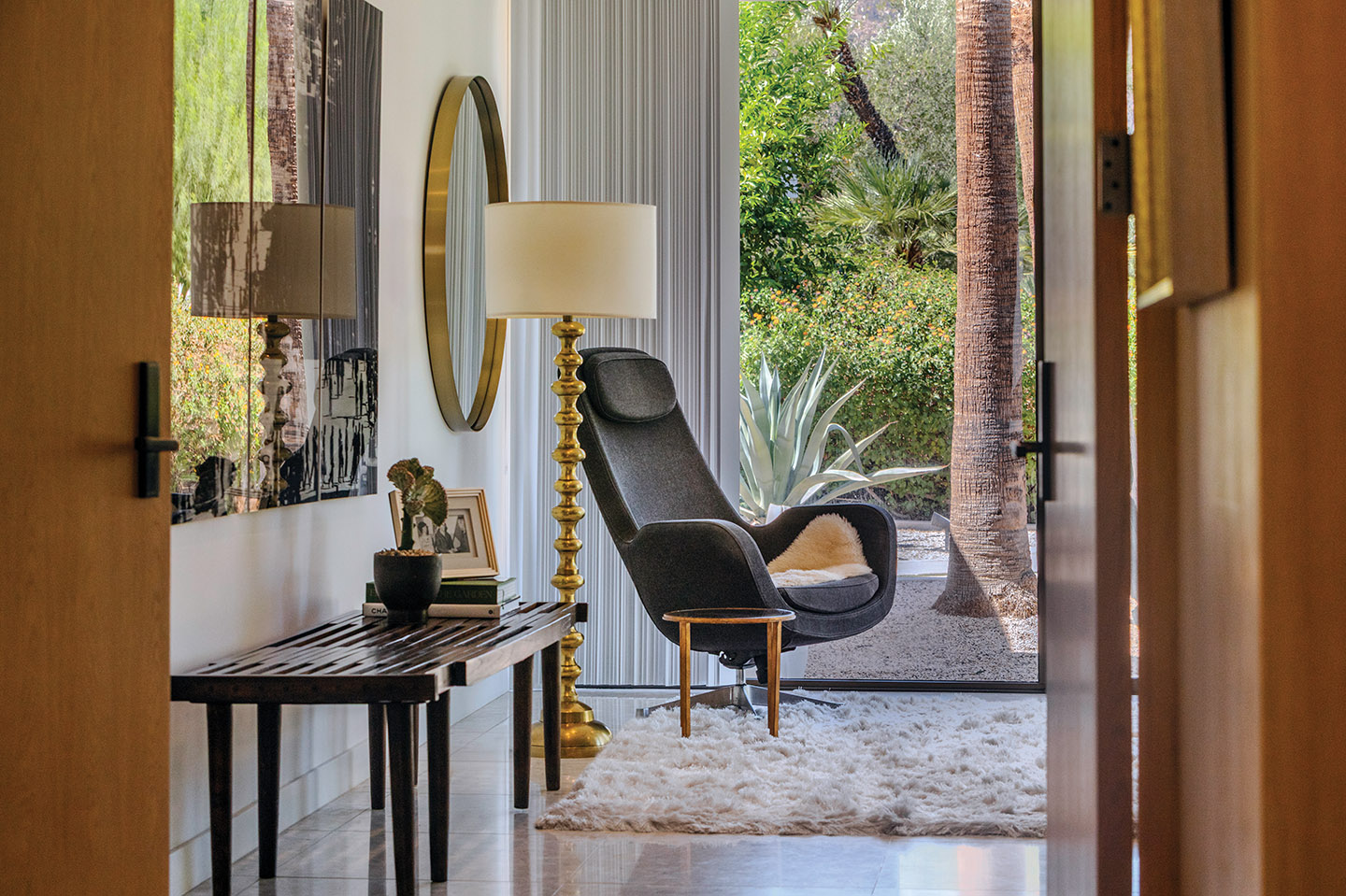
Sitting area in Millar and Guariso’s office.
Photo by scott pasfield, courtesy Robert Andrew Millar & Associates
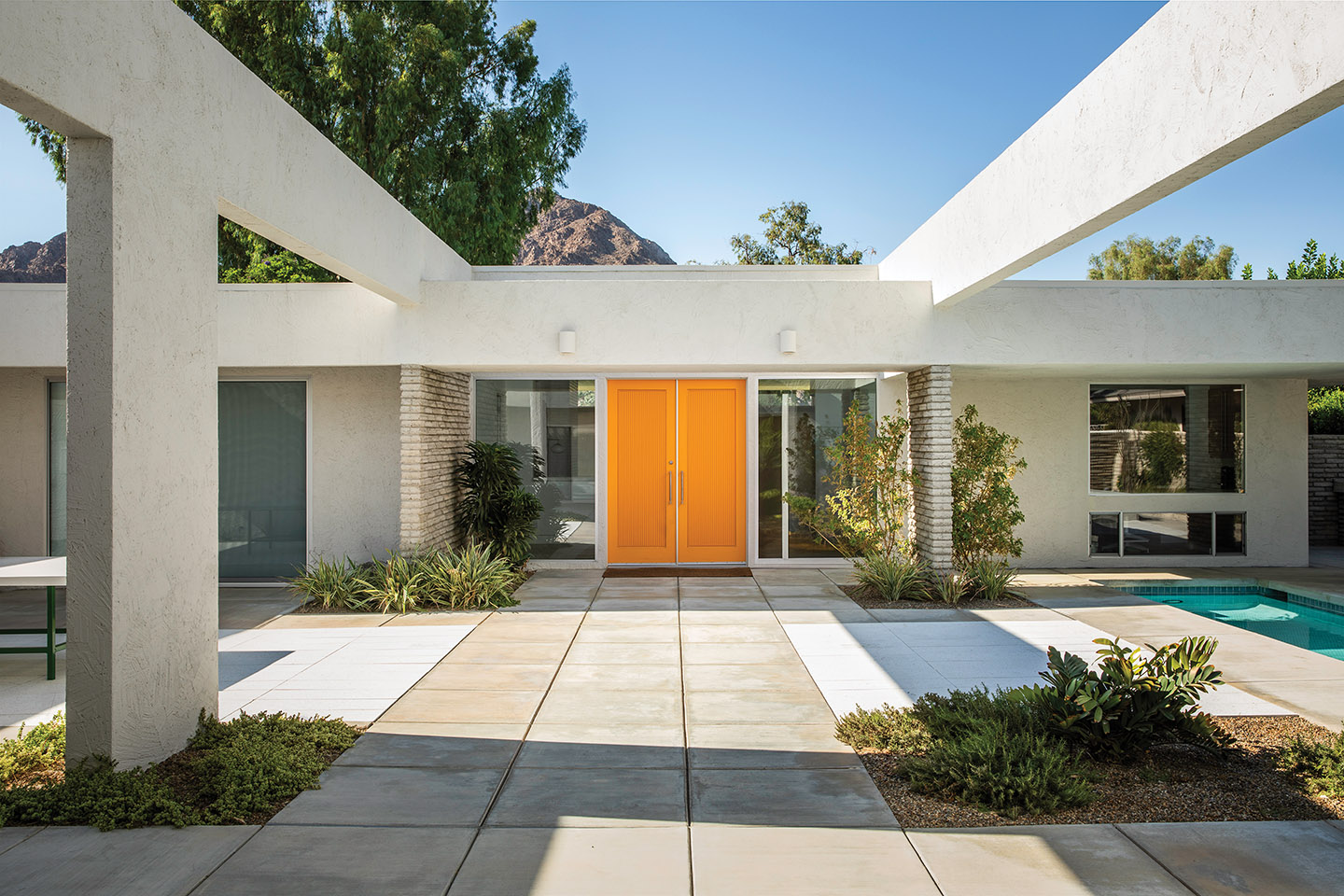
1967 George Kocher residence.
Photo by scott pasfield, courtesy Robert Andrew Millar & Associates
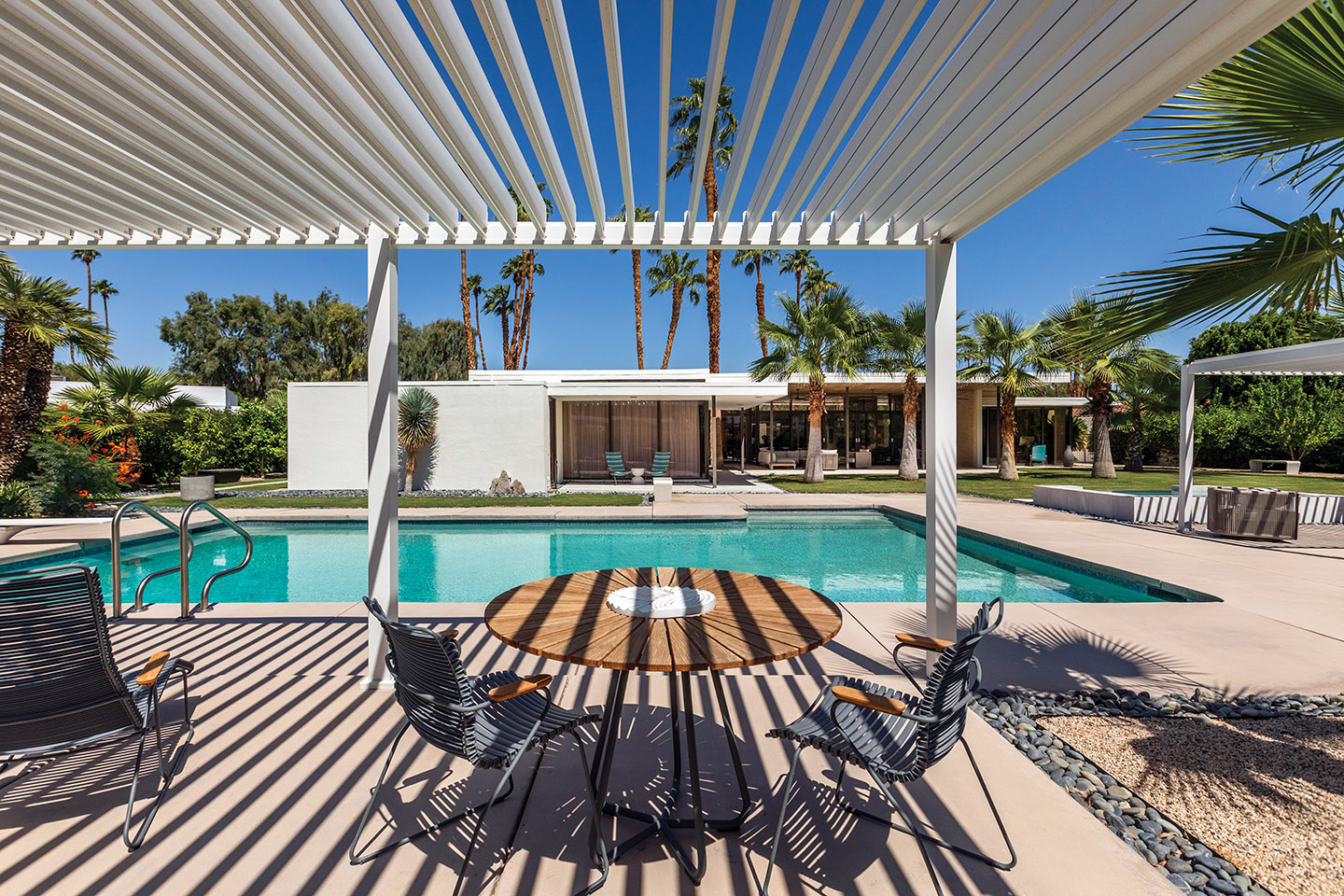
Millar and Guariso’s covered outdoor living space.
Photo by scott pasfield, courtesy Robert Andrew Millar & Associates
Millar’s own home brings a warmer register to the tour — duskier and brickier than its sleeker counterparts. The 1969 Robert Ricciardi design — updated by O’Donnell in 2010 and renovated again in 2024 by Millar’s husband, designer Mario Guariso — moves from a low-key street façade into a long, glassy pavilion opening onto pool, palms, and par. Apropos of the couple’s recreational tendencies, the fairway reads as borrowed scenery rather than main event. “We don’t play golf,” Millar says. “We’re pickleball people.”
Lest you assume the tour will comprise one rectilinear marvel after another, a 1991 design by Laszlo Sandor provides a compelling shift. Filmmaker Matt Tyrnauer describes his 5,500-square-foot estate with a widescreen lens: “It has a confident midcentury-tycoon feeling,” he says, “with elements of high modernism, brutalism, post-modernism, and some Las Vegas Liberace — all constructed as a view machine for the mountains.” That plays out in glowing ceilings, mirrored planes, towering rooftops, and a stone protrusion pushing through the façade in a sculptural thrust.
Tyrnauer attributes this mashup to Sandor’s midcentury sensibilities — after all, he once practiced with Cody, who arguably claims a place on modernism’s Mount Rushmore — colliding with the scale and irony of the postmodern era. The result is a house that’s less an outlier than a natural expression of the desert’s evolving architectural story. For as much as preservation efforts have turned Palm Springs into a globally recognized time capsule of midcentury architecture, design movements rely on motion.
Leuschner links this fluidity to a concept in Marshall Berman’s 1982 book, All That Is Solid Melts Into Air: The Experience of Modernity. “Under capitalism, there’s always a desire for newness,” Leuschner explains. “That’s why styles are constantly developing and iterating. Nothing in progress stays around forever.”
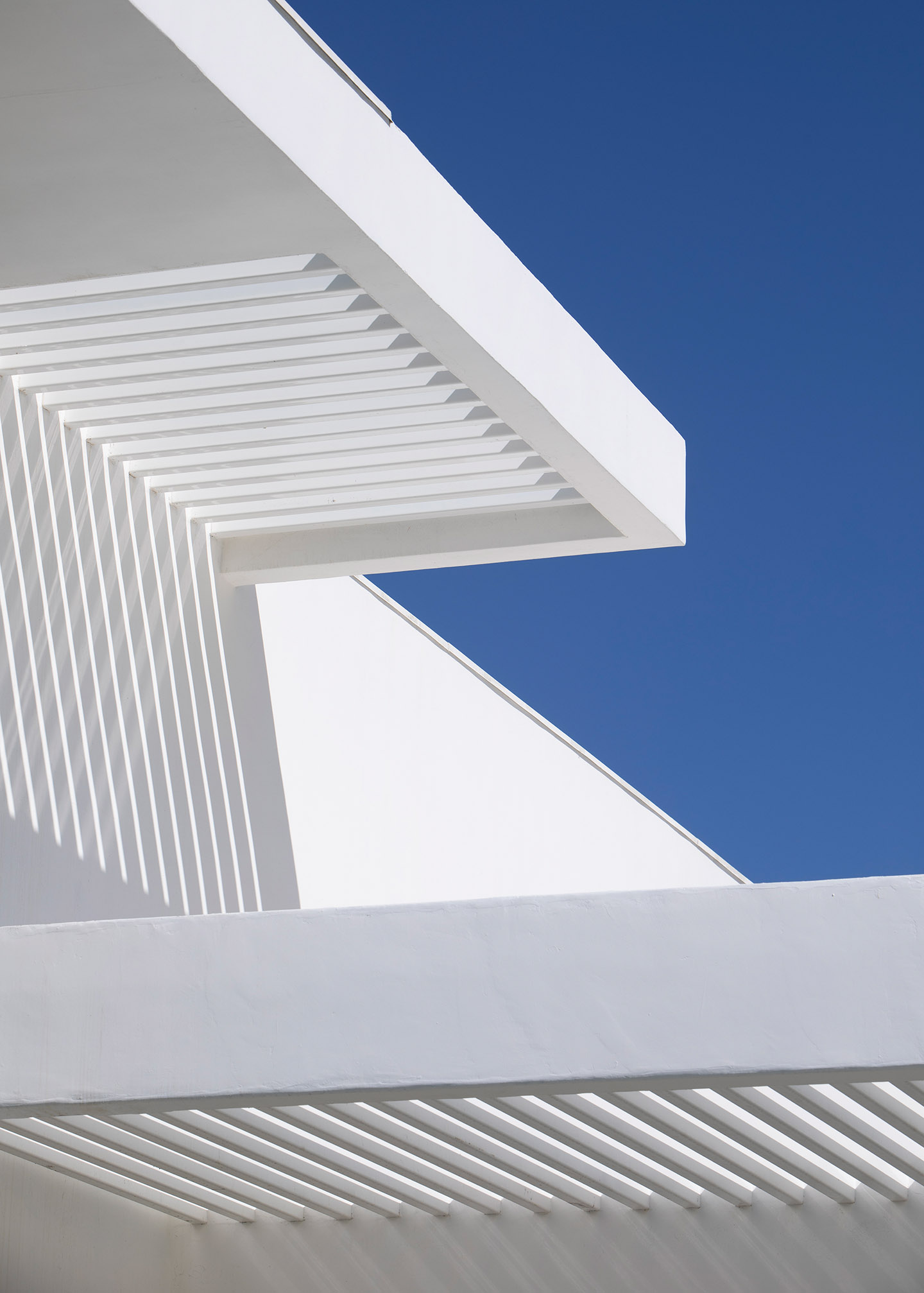
Details of Millar’s La Quinta Country Club home, which will open next month for Modernism Week tours.
That instinct is clear in La Quinta’s 2023 Historic Resources Survey and Context Statement, which catalogs more than a dozen architectural styles — from Monterey to Moderne, Pueblo to post-and-beam — that have shaped the city since the early 1900s. And the story stretches beyond the architects already mentioned: La Quinta also includes work attributed to Cliff May, Walter White, and S. Charles Lee, with God knows how many other notable structures still hiding in plain sight, or even tragically lost. Lee’s 1937 Desert Club, La Quinta’s first — and possibly only — Streamline Moderne building, was destroyed during firefighting drills by California Department of Forestry in 1989.
If all goes well, the tour will draw attention to a marvelous concentration of preservation-ready modernism outside the usual center of gravity.
Tyrnauer, who will deliver a keynote at the reception following the tour, hopes La Quinta Country Club’s Modernism Week debut broadens the architectural narrative — a shift that challenges what urban historian Sharon Zukin calls a “symbolic economy,” in which a single branded center (ahem, Palm Springs) monopolizes a narrative better shared across the valley. “There’s an unbroken chain of inspiration and brilliant architecture all the way from the windmills to the Salton Sea,” Tyrnauer says. “It’s a revelation.”